





Weaving Threads of Unity: The Expansive Historical Narrative of African Women’s Football
In the intricate fabric of Africa’s sporting legacy, women’s football stands as a dynamic emblem of perseverance, cultural reclamation, and collective empowerment. Its origins delve deep into the colonial era, where European-imposed recreational structures intersected with traditional African communal activities, often sidelining women in favor of male-dominated pursuits. Yet, by the 1960s, sparks of resistance ignited across the continent. Guinea’s establishment of the first national women’s team in 1965 marked a seminal moment, challenging entrenched gender norms amid post-independence fervor. In West Africa, Nigeria’s informal leagues burgeoned in the 1970s, with clubs like the Adesukhumwu Ladies defying societal taboos through community-driven matches that blended athleticism with social activism, transforming dusty fields into arenas of female solidarity.
The formal institutionalization arrived in 1991 under the Confederation of African Football (CAF), which launched the Women’s Africa Cup of Nations (WAFCON) as a Pan-African platform aligning with global milestones like the inaugural FIFA Women’s World Cup. This tournament not only formalized competition but also symbolized Africa’s assertion of autonomy in a sport long dominated by Northern hemispheres. Nigeria’s Super Falcons quickly dominated, securing 12 titles by 2025, their unyielding prowess a narrative of strategic investment and raw talent. South Africa’s Banyana Banyana, emerging post-apartheid in the 1990s, captured hearts with their 1995 debut victory, while North African sides like Algeria and Morocco infused the game with tactical finesse, their 2004 and 2022 triumphs highlighting regional diversity.
The evolution accelerated in the 21st century, influenced by broader socio-political shifts, including the African Union’s Agenda 2063, which emphasized gender inclusion in development. Grassroots movements in countries like Kenya and Uganda fostered youth academies, drawing from oral traditions of communal play to build modern infrastructures. By the 2020s, the sport had transcended borders, with diaspora players returning to bolster national squads, embodying a Pan-African ethos where football serves as a bridge across ethnic, linguistic, and economic divides.
A watershed moment came with the 2025 WAFCON, expanded to 16 teams and hosted by Morocco from July 5 to 26—delayed from initial March dates due to logistical harmonization with global calendars. This edition, the first with such scale, featured qualifiers like Cameroon, Egypt, Ivory Coast, and Mali, elevating underrepresented voices. Nigeria clinched their 12th title with a thrilling 3-2 final victory over hosts Morocco, while Ghana secured third place via a 4-3 penalty shootout against South Africa. As a qualifier for the 2027 Women’s World Cup in Brazil, where the top four advanced, the tournament underscored a shift toward inclusivity, with upsets like Zambia’s semi-final run illustrating narrowing competitive gaps. This historical progression reflects football’s role in Pan-African unity: a vehicle for healing colonial scars, fostering interstate dialogue, and amplifying women’s agency in a continent where sports increasingly mirror societal transformations.
Trailblazers on the Pitch: Celebrating the Pioneers and Rising Stars of African Women’s Football
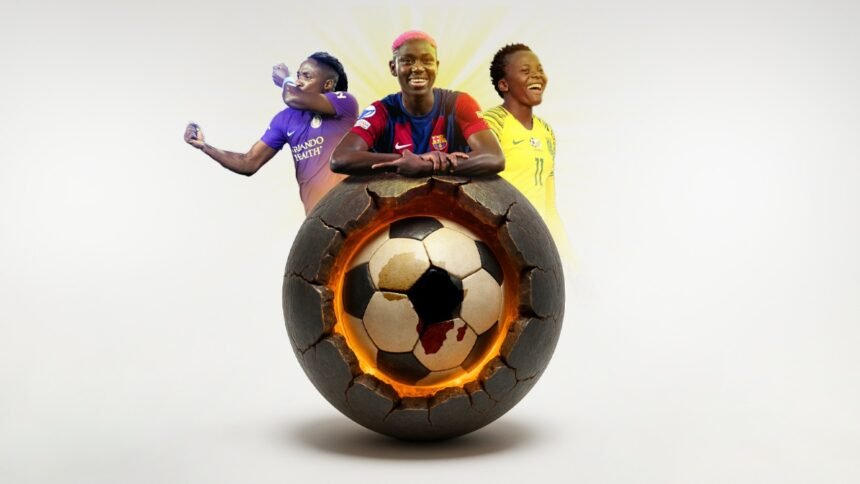
The heartbeat of African women’s football resonates through its extraordinary athletes—women who shatter barriers with every stride, inspiring a continent to envision boundless possibilities. At the forefront remains Nigeria’s Asisat Oshoala, a six-time CAF African Women’s Footballer of the Year whose predatory instincts have redefined forward play. In 2025, Oshoala’s pivotal goals in WAFCON, including a brace in the final against Morocco, solidified her legacy, transitioning from Barcelona’s elite leagues to mentoring emerging talents in Nigerian academies. Her journey from Lagos streets to global stardom encapsulates resilience, blending technical brilliance with advocacy for girls’ education.
Complementing her is Zambia’s Barbra Banda, whose explosive pace and scoring prowess propelled the Copper Queens to new heights. In 2025, Banda’s hat-trick in the WAFCON quarter-finals and her record-breaking transfer to Orlando Pride in the NWSL highlighted her as a symbol of Southern African ascent. Her teammate, Racheal Kundananji, continued her trailblazing path, becoming the most expensive women’s transfer in history at Bay FC, her versatility in attack embodying Zambia’s tactical evolution. South Africa’s Thembi Kgatlana, nominated for the 2025 CAF Awards, dazzled with her wing play, her 2025 Ballon d’Or Féminin shortlist nod amplifying Banyana Banyana’s global footprint amid their Olympic campaigns.
From Central Africa, Cameroon’s Ajara Nchout Njoya remains a force, her leadership guiding the Indomitable Lionesses to consistent World Cup qualifications, while Morocco’s Ghizlane Chebbak orchestrated midfield mastery in the 2025 final, her composure under pressure reflecting North Africa’s growing investment in women’s programs. Emerging icons like Kenya’s Vivian Corazone Aquino, whose grassroots rise led to European contracts, and Uganda’s Lilian Mutuuzo, a defensive stalwart in the CECAFA region, diversify this elite cadre. In 2025, only three Africans—Oshoala, Banda, and Kgatlana—made the FIFPRO Women’s World 11 shortlist, underscoring both progress and the need for broader recognition.
These women are more than athletes; they are cultural ambassadors, challenging stereotypes through initiatives like Oshoala’s foundation for underprivileged girls and Banda’s anti-gender violence campaigns. In a Pan-African context, their stories weave a tapestry of empowerment, where individual triumphs fuel collective movements, inspiring millions to lace up boots and claim the pitch as a domain of feminine strength and innovation.
Front-Runners of the Continent: Dominant Nations Shaping the Landscape of Women’s Soccer
Africa’s women’s football arena is a vibrant hierarchy of powerhouses and aspirants, where established giants inspire rising challengers in a symphony of continental competition. Nigeria leads unequivocally, their FIFA ranking hovering in the global top 30 by late 2025, bolstered by a 12th WAFCON crown and consistent World Cup performances. The Super Falcons’ success stems from robust domestic leagues like the NWFL, which nurture talents through youth systems, blending West African flair with disciplined strategy.
South Africa, continental runners-up in investment and performance, leverages post-apartheid policies for gender equity; Banyana Banyana’s 2022 WAFCON win and 2025 third-place battle reflect a model of holistic development, from school programs to professional contracts. Morocco’s Atlas Lionesses, surging post-2022 World Cup semi-finals, hosted and reached the 2025 final, their royal-backed infrastructure—modern stadiums and academies—positioning North Africa as a hub, with FIFA U-17 Women’s World Cup hosting in 2025 further elevating their profile.
Cameroon’s Lionesses maintain Central African dominance, their bilingual squads excelling in physicality and endurance, qualifying for multiple globals. Zambia (fifth-ranked) and Ghana (sixth) inject vitality; the Copper Queens’ 2025 semi-finals and Black Queens’ penalty heroics signal a southward shift, fueled by mining-sponsored leagues. Tunisia, Senegal, and Tanzania ascend through zonal tournaments, while Botswana and Algeria’s WAFCON showings hint at broader diffusion.
This vanguard fosters a Pan-African rivalry that sharpens edges: Nigeria’s dominance spurs emulation, as mid-tier nations like Malawi invest in scouting, closing gaps evident in 2025’s upsets. Football here transcends sport, aligning with AU goals for unity, where national pride converges in shared continental aspirations.
Cultivating Fertile Grounds: Strategic Investments Fueling Sustainable Growth
The blossoming of African women’s football demands intentional nourishment—investments that convert latent potential into enduring ecosystems. CAF’s 2024-25 agenda, amplified by FIFA Forward’s $1.25 billion, earmarked over 25% for women’s initiatives, launching 50+ competitions and upgrading facilities in Morocco, Zambia, and Nigeria. The 2025 WAFCON’s prize money surge—to $2.5 million for winners—marks a 150% increase, incentivizing participation and professionalization.
Corporate partnerships catalyze this: South Africa’s Hollywoodbets R17 million deal with the SAFA Women’s League bolsters salaries and marketing, while MTN’s continent-wide digital platforms enable virtual scouting, reaching remote talents. Philanthropic efforts, like Absa Group’s clinics training 10,000 girls annually, diversify funding, blending merchandise and broadcasting revenues to offset infrastructure gaps. Yet, disparities persist; elite nations reap benefits, while Sahelian federations seek modest grants for basic kits.
Strategic visions extend to youth: CAF’s inaugural U-17 and U-20 WAFCONs in 2026 promise pipelines from village pitches to international arenas. In this cultivation, investments embody Pan-African covenants—pledges ensuring economic sustainability intertwines with athletic excellence, sowing seeds for a harvest where women’s football thrives as a viable industry.
Orchestrating Equity: Collaborative Efforts by UN and AU in Advancing Gender Parity
The pursuit of gender equality in African sports finds harmonious amplification through United Nations and African Union synergies, positioning women’s football as a catalyst for profound societal change. The AU’s Agenda 2063 integrates sport into gender frameworks, viewing it as a tool for empowerment and peace. Icons like Kenya’s Tegla Loroupe, an AU envoy, exemplify this, leveraging her athletic legacy to advocate for women’s inclusion in conflict resolution via sports diplomacy.
UN Women’s 2025 partnership with the International Working Group on Women and Sport channels resources into African programs, such as GIZ’s S4DA initiatives empowering 5,000 girls through soccer-based leadership training. AU-UN summits in Addis Ababa enforce policies like 30% female coaching quotas, while metrics track access parity from Sahara to savannas. The 2025 African Women in Sports Summit in Kampala and Dakar conferences foster networks, addressing gender-based violence and investment barriers.
These collaborations yield integrative outcomes: football pitches become dialogues on health and autonomy, promoting SDGs. Yet, deeper orchestration is needed—a Pan-African symphony where UN-AU alliances compose lasting equity, ensuring women’s football echoes as an anthem of inclusion and resilience.
Confronting the Terrain: Persistent Challenges Amid Strides Toward Equality
Despite ascendant trajectories, African women’s football navigates a labyrinth of obstacles that demand unwavering resolve. Funding chasms loom large: many teams endure sporadic stipends, their preparations dwarfed by male allocations, as seen in 2025’s WAFCON where peripheral squads faced travel woes. Infrastructure voids exacerbate this—Senegalese and Malawian players train on uneven grounds lacking medical support, eroding potential.
Societal barriers cut deeper: patriarchal attitudes label female athletes as outliers, with homophobia and racism compounding isolation, as in Nigerian cases of derogatory labeling. Leadership imbalances persist; women occupy scant executive roles, perpetuating decisions misaligned with their needs. Media disparities, though improving with 2025’s broadcast expansions, still undervalue women’s games.
These challenges, framed in Pan-African discourse, are crucibles for innovation—federations must confront biases through advocacy, transforming hurdles into stepping stones for a more equitable future.
Horizon of Triumph: Charting a Bold Future for African Women’s Football
As Africa’s dawn brightens, women’s football emerges poised for dominance—a future where expansion catalyzes transformation. Post-2025 WAFCON, with its record attendance and media buzz, CAF targets 60 million female players by 2027 via academies spanning the continent. Morocco’s 2030 World Cup co-bid and U-17 hosting radiate infrastructural waves, while new youth tournaments democratize access.
Prize surges and corporate influxes promise financial parity, luring global broadcasters to amplify narratives. Challenges evolve into opportunities: funding via public-private models, equity through AU mandates, birthing a diaspora of unbound stars. This vista is a manifesto—a Pan-African vow that women’s football, once marginalized, now pulses as the continent’s core, every victory a stride toward eternal eminence.


