





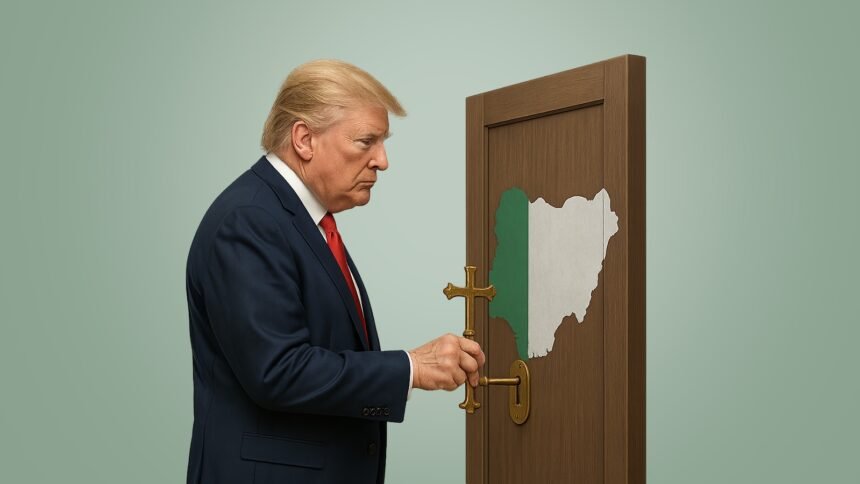
Beneath the clamor of President Donald Trump’s fiery denunciations of “Christian slaughter” in Nigeria lies a stark geopolitical maneuver: a high-stakes American bid to force Nigeria—the continent’s unrivaled powerhouse—into invading or menacing Niger to resurrect the shuttered U.S. drone fortress at Agadez. This is no altruistic crusade for faith; it is a calculated power play to reclaim Washington’s eyes in the sky over the Sahel, lost when Niger’s sovereign junta expelled U.S. forces in 2024. Nigeria, the beating heart of Africa’s dreams and the architect of its modern unity, stands unbowed. With the proud legacy of leading the African Union’s birth, crushing apartheid’s chains, and taming Boko Haram’s terror through homegrown grit, Abuja debunks Trump’s belligerence as the desperate rattle of an empire clinging to relevance. The Giant of Africa will not be dragooned into proxy wars; it chooses mediation, multilateralism, and the unbreakable spirit of Naija sovereignty.
Pan-African Sentinel: Nigeria as the Continent’s Unyielding Vanguard
Africa’s solidarity is not a slogan but a living force, forged in the fires of decolonization and tempered by shared scars. When Niger’s military council—born of a 2023 coup against a pro-Western regime—booted American troops from Air Base 201 in Agadez, it struck a blow for continental dignity. That sprawling complex, costing Washington over $110 million, hosted MQ-9 Reaper drones, 1,000 personnel, and a nerve center for tracking jihadists from Lake Chad to the Libyan dunes. Its closure blinded U.S. counter-terror operations, ceded influence to Russian Wagner mercenaries, and emboldened China’s infrastructure diplomacy. Trump, sensing strategic hemorrhage, now brandishes Nigeria as the battering ram to reverse this humiliation.
Yet Nigeria, the cradle of Pan-Africanism, refuses to act as an enforcer. From the 1960s, when it bankrolled liberation movements in Angola and Zimbabwe, to its pivotal role in the birth of the AU in 2002, Nigeria has championed African solutions on African terms. President Bola Tinubu’s administration, echoing the immortal cadence of Nnamdi Azikiwe and Obafemi Awolowo, has dispatched envoys to Niamey, Bamako, and Ouagadougou, weaving a tapestry of dialogue under the Alliance of Sahel States framework. Abuja offers Niger joint border patrols, intelligence fusion centers, and economic lifelines—never ultimatums. This is Pan-Africanism in action: a refusal to let foreign powers script fratricidal scripts on African soil.
Naija’s Strategic Sonata: Diplomacy Over Invasion, Wisdom Over Wrath
Nigeria’s response to Trump’s threats is a masterclass in statecraft, orchestrated with the precision of a Fela Kuti riff—bold, layered, and defiantly indigenous. Within 48 hours of Trump’s November 1 Truth Social tirade, labeling Nigeria a “disgraced country,” Tinubu convened the National Security Council in Aso Rock—the verdict: no military mobilization toward Niger, no saber-rattling, only a surge in shuttle diplomacy. Special envoy Ambassador Babagana Kingibe, a veteran of ECOWAS peace missions, flew to Niamey bearing proposals for a phased U.S. presence in Agadez under AU oversight—contingent on Niger’s reintegration into regional bodies and democratic reforms.
This is not capitulation; it is the calculus of a nation that has stared down existential threats. Nigeria’s military, the largest in West Africa with over 200,000 active personnel, has degraded Boko Haram from a proto-caliphate controlling 20,000 square kilometers in 2015 to scattered cells today—through community vigilance, Super Tucano strikes, and deradicalization programs that reintegrated 2,000 fighters. Invading Niger would ignite a regional inferno, radicalizing youth from Kano to Gao and handing jihadists a propaganda windfall. Instead, Nigeria deploys soft power: $500 million in humanitarian aid to Sahel refugees, tech hubs training Chadian and Nigerien coders to monitor extremist chatter, and the Multinational Joint Task Force, which has neutralized 1,500 militants since 2023. Trump’s demand for invasion is thus exposed as strategic myopia—Nigeria counters with the long game of sustainable security.
Deconstructing the Eagle’s Masquerade: Faith as Pretext, Bases as Prize
Trump’s invocation of “cherished Christians” being “slaughtered by radical Islamists” is a carefully crafted mirage. The violence plaguing Nigeria’s Middle Belt—over 2,200 deaths in 2025 alone—stems from ecological collapse, elite corruption, and governance failures, not a genocidal holy war. Fulani herders, displaced by desertification, clash with sedentary farmers over shrinking arable land; both sides suffer, with Muslims and Christians among the dead. Human Rights Watch and the International Crisis Group concur: no evidence supports Trump’s narrative of targeted Christian extermination. Yet this fiction serves a purpose—to manufacture moral cover for reclaiming Agadez.
The base’s strategic value is undeniable. From Agadez, U.S. drones once flew 100 sorties monthly, gathering signals intelligence on ISWAP supply lines and al-Qaeda convoys. Its loss forced relocation to distant bases in Djibouti and Sicily, tripling flight times and slashing coverage. Trump’s inner circle—advised by hawks like Senator Ted Cruz and evangelical lobbyists—sees Nigeria’s 100 million Christians as a domestic voting bloc to rally. But Nigeria’s interfaith fabric, where Lagos mosques and Enugu cathedrals stand blocks apart, dismantles this divisive trope. First Lady Remi Tinubu, a Redeemed Christian Church of God pastor, has toured conflict zones, preaching unity and distributing aid to Muslim and Christian widows alike. Trump’s religious framing is thus a hollow gong—Nigeria answers with the lived harmony of its 250 ethnicities.
Forging the Anti-Terror Trident: Africa’s Indigenous Arsenal
Counter-terrorism need not be an American monopoly. Nigeria has pioneered a tripartite model—kinetic, kinetic-adjacent, and kinetic-preventive—that outshines Trump’s drone-centric dogma. The kinetic prong: Operation Hadin Kai, which has liberated 1,000 communities and seized 500 weapon caches since 2021. The kinetic-adjacent: the Civilian Joint Task Force, 26,000 local hunters turned sentinels, whose granular knowledge of terrain foils ambushes. The preventive: the North East Development Commission, channeling $1 billion into schools, solar farms, and agro-processing hubs, starving extremism of its recruitment pool.
Contrast this with Trump’s vision: Nigerian boots storming Niger to secure Agadez for U.S. Predators. Such an operation would require 50,000 troops, $10 billion annually, and risk a quagmire akin to Afghanistan’s graveyards. Nigeria instead scales African innovations: the Accra Initiative, linking intelligence across eight Sahel states; the Nouakchott Process, coordinating air assets; and the G5 Sahel’s revival under Nigerian mediation. By 2026, Abuja aims to deploy 5,000 peacekeepers to Niger’s Tillabéri region under an AU mandate—securing borders without subjugating sovereignty. This is counter-terrorism with an African soul, rendering Trump’s invasion fantasy obsolete.
Transatlantic Fault Lines: When Partnership Becomes Patronage
U.S.-Africa relations under Trump have devolved into a transactional farce. An annual aid package of $1 billion to Nigeria—primarily for health and security—is dangled as leverage, with threats of sanctions if Abuja balks. Yet Nigeria’s economy, Africa’s largest at $510 billion GDP, is diversifying beyond oil: fintech unicorns like Flutterwave process $20 billion yearly, Nollywood exports $1 billion in content, and the AfCFTA positions Lagos as the continent’s trade nerve center. Sanctions would sting—naira volatility, investor flight—but Nigeria has weathered worse: the 2016 recession, when oil crashed 70%, saw GDP rebound 4% within two years through local refining and tech.
Trump’s policy ignores this resilience, treating Africa as a client state. Nigeria counters with strategic autonomy: deepening ties with the EU (which pledged €150 million for Sahel stability), courting Japan for rail tech, and anchoring the D-8 bloc with Turkey and Indonesia. The message is clear: partnerships must be mutual, not coercive. Nigeria will share intel on jihadist financiers in Dubai, co-train Nigerien officers in Abuja’s staff college, and host U.S. liaison teams—but never at the cost of marching on Niamey.
Naija Nationalism Ablaze: From Street Chants to Statecraft
Across Nigeria, Trump’s threats have kindled a nationalist renaissance. In Lagos, #NaijaNotForSale trends as traders in Balogun Market vow to boycott U.S. brands. In Kano, imams and bishops lead joint prayers for peace, decrying foreign meddling. The Nigerian Senate, in a rare bipartisan resolution, condemned “external dictates” and pledged $200 million to fortify northern borders. Youth activists, wielding TikTok and X, remix Fela’s “Zombie” with captions: “We no be Trump’s zombie o!”
This fervor echoes 1960, when Nigeria’s independence anthem drowned colonial echoes. It recalls 1993, when the nation defied military dictatorship to restore democracy. Today, it manifests in policy: Tinubu’s “Renewed Hope” agenda accelerates rail links to Niger, aiming for 1 million tons of cross-border trade by 2027, binding economies tighter than threats ever could. Nigerian nationalism is not jingoism but justified pride—a refusal to let Agadez’s ghost haunt African futures.
Sahel Peace Mosaic: Nigeria’s Vision for a United Frontier
The path to Sahel stability winds through dialogue, not drone strikes. Nigeria proposes a Grand Sahel Accord: a 10-year pact under AU auspices, with Niger gradually reopening Agadez to a multinational force—U.S., French, and African contingents—under ECOWAS command. Funding: $5 billion from G20 pledges, managed by the African Development Bank. Benchmarks: Niger’s return to constitutional rule by 2027, joint counter-terror ops reducing attacks 50% by 2030, and 10 million hectares of reforested grazing corridors to end farmer-herder wars.
This is Nigeria’s gift to the continent: a blueprint where security serves people, not powers. From the markets of Maradi to the mosques of Maiduguri, trade will flow, youth will code, and children will study under solar lamps—not cower under foreign shadows. Trump’s gambit, for all its bluster, crumbles before Nigeria’s quiet thunder—the roar of a Giant that chooses brotherhood over bayonets, sovereignty over subjugation, and the radiant dawn of African agency over the twilight of imperial nostalgia.


