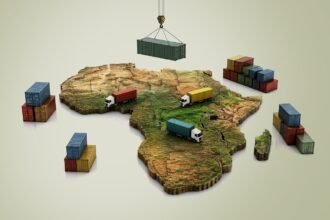





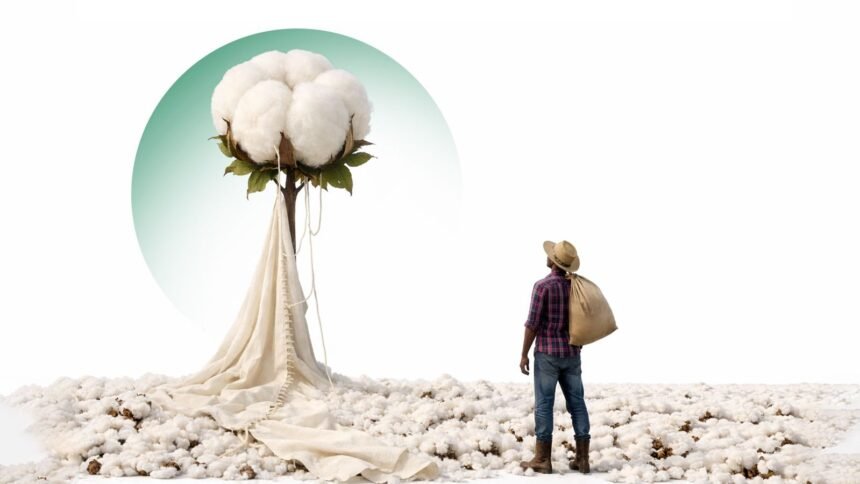
On the eastern edge of Cotonou, where the road to the port slips past repair yards and low concrete warehouses, trucks loaded with tightly wrapped cotton bales inch toward the docks. For decades, this has been West Africa’s assigned role in the global fashion economy: harvest the cotton, press it into fiber, and ship it elsewhere to be turned into clothes.
The cutting, sewing, and branding that create most of the value and most of the jobs still happen thousands of kilometers from the fields where the crop is grown.
This story matters now because a group of West and Central African governments is trying to turn cotton from a raw export into a foothold in manufacturing amid a wider global struggle over who controls value chains in textiles, climate‑conscious consumption, and trade.
Cotton, Numbers, and Leverage
Cotton has long been woven into the economies of the Cotton‑4 countries: Benin, Burkina Faso, Chad, and Mali, joined in recent years by Côte d’Ivoire and several neighbors under the Cotton‑4+ banner.
In Benin and Burkina Faso, cotton accounted for roughly 69 percent and 47 percent of agricultural export earnings in 2020, according to the Food and Agriculture Organization, and the group’s exports are expected to stay near one million tons a year through the next decade. Yet almost all of that volume still leaves the continent as raw fiber.
The World Trade Organization estimates that about 90 percent of the roughly one million tons of cotton produced in Africa is exported unprocessed, with only around 2 percent currently transformed on the continent, even though West and Central Africa together account for more than a fifth of global cotton output.
WTO Director‑General Ngozi Okonjo‑Iweala has argued that this model locks African producers at the bottom of value chains. In recent remarks alongside African trade ministers, she urged governments to “end the export of 90 percent” of cotton as raw fiber and push processing volumes up to around a quarter of production over the next decade.
The quietly revealing point is that in today’s trade politics, a bale of cotton is as much a bargaining chip over industrial policy and subsidies as it is a farm commodity.
The latest iteration of that bargaining is the Partnership for Cotton, a WTO‑backed initiative that has evolved from a trade complaint into an investment pitch. At a high‑level event in Yaoundé ahead of the organization’s 14th ministerial conference, the Cotton‑4+ countries and their partners set out new targets:
roughly 5 billion dollars in public and private investment over ten years, with the promise of around 500,000 direct jobs in ginning, spinning, textiles, logistics, and fashion if factories and supporting infrastructure materialize.
To make that feel less abstract to financiers, they unveiled Africa Textile Invest. This digital platform aggregates data on industrial zones, policy regimes, and project pipelines across West and Central Africa, essentially turning a diplomatic initiative into a searchable deal book.
Ground-Level Shifts and Experiments
For cotton farmers in the hinterlands of Koutiala or Kandi, the promise of local processing can feel distant. Over the past two decades, Burkina Faso’s “white gold” has seen its share of national export revenue fall from more than half to just a few percentage points, even as farmers continue to plant each season.
International reports describe a familiar pattern: smallholders as price takers in a volatile global market, exposed to swings in demand, subsidies abroad, and climate shocks at home.
Development agencies backing the Partnership for Cotton argue that retaining more of the value chain in the region could create stabilizing jobs nearby, in ginning plants, warehouses, and small factories, even if world prices remain unpredictable.
Some governments are already testing that proposition at the city scale. In Togo, the Plateforme Industrielle d’Adétikopé textile park outside Lomé has been set up to turn about 56,000 tons of cotton fiber worth roughly 73 million dollars into garments with an export value closer to 1.5 billion dollars, using integrated facilities from ginning to finishing.
A first large apparel factory, run by Sri Lanka’s Star Garments with IFC backing, is ramping up at the site and is expected to employ several thousand workers by the end of the decade.
For officials in the Cotton‑4+ capitals, that kind of multiplier effect, a modest volume of fiber underpinning a much larger volume of clothing exports and jobs, is the template they would like to replicate further north.
Regional financiers are positioning themselves in anticipation. Afreximbank, which already finances trade across the continent, has taken a visible role in the Partnership for Cotton steering structures and promotes the cotton‑to‑garment chain as a target sector for new credit lines and project finance.
Bank officials, along with the African Development Bank and others, argue that with the African Continental Free Trade Area slowly moving from text to reality, there is headroom to build regional markets for “Made in Africa” textiles well before factories compete head‑to‑head with the biggest Asian hubs.
The question in Cotonou or Ouagadougou is whether those institutions will be able to underwrite risk at the pace and scale that private investors demand.
On the ground, the constraints are familiar. Many cotton‑growing regions lack reliable electricity, paved feeder roads, or efficient ports, and skilled labor for spinning and garment production remains limited, even after decades during which those industries developed elsewhere.
Smallholders often have little direct contact with textile or fashion buyers and limited leverage over the conditions in which ginneries or factories operate. In that sense, the cotton initiative is as much about building ancillary systems, power lines, training centers, and industrial land‑use plans as about any single mill or plant.
Policy Fault Lines, and Futures
Supporters of the Partnership for Cotton insist that it is not just an industrialization scheme but also a way to reset long‑running trade grievances. For years, the Cotton‑4 countries have used WTO meetings to press their case against what they see as unfair subsidies for cotton producers in richer countries, arguing that those payments depress world prices and erode African farmers’ incomes.
By tying investment in factories and jobs directly to that agenda, they hope to make an abstract dispute over domestic support more legible to their own citizens, and harder for trading partners to treat as a technical side issue.
Skeptics point to steep headwinds. Textile and garment production is one of the most competitive and cost‑sensitive industries in the world, with established hubs in South and East Asia benefiting from decades of accumulated expertise, dense supplier networks, and logistics tuned to just‑in‑time orders.
Some trade analysts question whether West and Central African producers can reach sufficient scale and reliability to overcome higher power costs, infrastructure gaps, and governance risks, even with concessional finance.
Environmental advocates add a different concern: cotton is water‑ and pesticide‑intensive, and ramping up production or processing without stronger sustainability standards could undermine climate and biodiversity goals.
The official response has been to fold sustainability into the pitch. A complementary initiative involving the WTO and the United Nations Industrial Development Organization is seeking up to 12 billion dollars for “sustainable cotton” in Africa, including cleaner technologies, certification schemes, and support for farmers to adopt climate‑resilient practices.
The Togo textile park, for example, has emphasized renewable power and water recycling as part of its offering to brands looking to de‑risk supply chains under tighter environmental scrutiny.
In Yaoundé, speakers repeatedly linked the cotton agenda to broader efforts to cut trade costs, harmonize standards, and implement AfCFTA rules that might one day allow yarn spun in one country to be knit and stitched in another without losing preferential market access.
Even so, much of the plan remains aspirational. The 5‑billion‑dollar investment figure is a target, not a secured envelope, and many of the projects highlighted on Africa Textile Invest are still at the feasibility study or memorandum-of-understanding stage.
The WTO’s own data underscore the scale of the challenge: Africa still exports around 60 percent of its goods in raw or minimally processed form, even as it accounts for only a small share of global trade.
Okonjo‑Iweala has framed the choice starkly, saying it is “time for Africa to intensify its efforts and increase production, shifting from a raw material exporter to goods and services of higher value,” but she also acknowledges that multilateral bodies can only convene; hard policy choices will fall to national governments.
Back at Cotonou’s docks, the cotton bales still move out much as they always have, shrink‑wrapped and anonymous, headed for ports and factories far beyond the Gulf of Guinea.
The open question is whether, a decade from now, more of that white fiber will stay in West and Central Africa long enough to be spun, dyed, and stitched into garments, and whether the farmers who grow it will see their work reflected in paychecks and factories closer to home, rather than only in export statistics and slogans about value addition.