





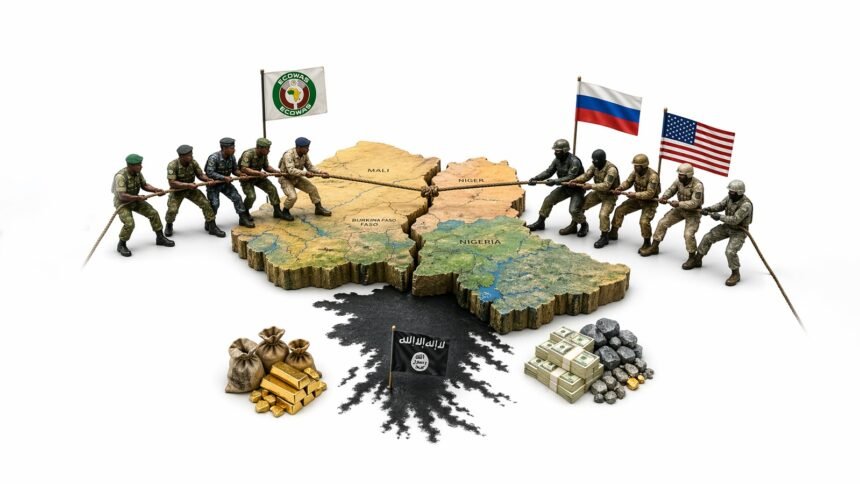
Pan-African Perspectives: Regional Sovereignty in an Era of Asymmetry
Across the West African landscape, the ideal of a unified “African solutions to African problems” is facing its most significant structural test since the era of decolonization. The emergence of the Confederation of Sahel States (AES) as a distinct military and political bloc comprising Mali, Niger, and Burkina Faso has created a dual-track security architecture in the region. This Pan-African fragmentation reflects a deeper debate over regional sovereignty. While the Economic Community of West African States (ECOWAS) maintains a focus on multilateral institutionalism, the AES states have pivoted toward a model of radical autonomy and bilateral security partnerships, challenging the long-standing hegemony of regional integration as the primary vehicle for stability.
Terrorism & Insurgency Outlook in West Africa: A Shifting Epicenter
The 2026 security outlook for West Africa is characterized by the consolidation of jihadist influence in the Liptako-Gourma “tri-border” region and the Lake Chad Basin. Affiliates of Al-Qaeda and the Islamic State, notably Jama’at Nusrat al-Islam wal-Muslimin (JNIM) and the Islamic State West Africa Province (ISWAP), have shifted their tactics from hit-and-run raids to the entrenchment of “shadow governance” over rural populations. This shift involves enforcing local taxes and providing basic judicial services, posing a direct challenge to state legitimacy. Furthermore, the expansion of these groups toward coastal states, including Benin, Togo, and Côte d’Ivoire, suggests that the insurgency is no longer a localized Sahelian phenomenon but a comprehensive regional threat.
Counter-Terrorism & Insurgency Efforts in West Africa: The Two-Tiered Response
Regional counter-insurgency efforts are currently divided between the newly endorsed ECOWAS Counter-Terrorism Brigade and the 6,000-strong AES Unified Force. In February 2026, ECOWAS chiefs of staff finalized the structure of a specialized brigade of 1,650 soldiers, with contributions from Nigeria, Senegal, and Ghana, intended to station contingents in their respective countries for rapid deployment. Simultaneously, the AES Unified Force represents a parallel effort by the central Sahelian states to coordinate cross-border operations without external oversight. The success of West African security in 2026 depends on whether these two forces can achieve “deconfliction” of operations or whether their political differences will lead to a fragmented, less effective defense against a mobile and innovative enemy.
West Africa-Russia Relations: The Shift Toward Strategic Quid Pro Quo
The relationship between several West African states and Moscow has undergone a fundamental transformation, evolving from liberation-era sentiment to a modern strategic quid pro quo. Since the 2024 deployment of Russian military instructors to Equatorial Guinea and the subsequent 2025 military cooperation agreement with Togo, Russia has positioned itself as the “partner of choice” for regimes prioritizing survival and kinetic military results. This relationship is often characterized by the provision of weapons, intelligence, and media operations in exchange for mining concessions and long-term mineral supply contracts. For many Sahelian leaders, Russia offers a “security-first” model that bypasses the democratic and human rights conditionalities often imposed by traditional Western partners.
West Africa-USA Relations: The Logic of “Phased Withdrawal”
The United States’ presence in West Africa is currently undergoing recalibration, moving toward a “phased withdrawal” from the Sahel while strengthening ties with coastal partners. Following the ejection of U.S. forces from Niger in 2024-2025, Washington has pivoted its counter-terrorism strategy toward the “Accra Initiative” states. This focus emphasizes capacity building for the intelligence and logistics wings of coastal militaries to prevent the “spillover” of jihadist violence. While the U.S. remains a primary provider of high-tech surveillance and maritime security support, its influence is increasingly challenged by a “multipolar reality” in which African states are actively shopping for more flexible security arrangements.
Russia vs. USA in West Africa: The Battle for Influence
The rivalry between Russia and the United States in West Africa has moved beyond mere diplomatic friction into a direct competition for security influence. Moscow has successfully exploited the perceived failure of French-led security efforts to displace Western partners in the “coup-belt” nations. Through the state-supported Africa Corps (the successor to the Wagner Group), Russia provides “regime security” that appeals to military juntas. Washington, conversely, maintains its influence through more established economic power and institutional support for regional blocs like ECOWAS. This competition has led to a fragmented security landscape where African governments often “pick sides,” potentially complicating the regional coordination necessary to combat transnational terrorist groups that do not respect geopolitical boundaries.
Using Mercenaries or Security Services: The Privatization of Protection
A controversial trend in 2026 is the increasing privatization of security, often blurring the lines between state-sanctioned “security services” and foreign “mercenaries.” In Mali and Burkina Faso, the reliance on the Africa Corps is presented by the state as a sovereign decision to procure specialized security services. However, human rights organizations view these groups as mercenaries whose primary allegiance is to their paymasters rather than the local populace. This “market for peace” risks shifting protection from a public good to a paid service, where security is often provided in exchange for resource concessions. The African Union is currently discussing updates to its 1977 convention against mercenarism to address these modern “opaque chains of command.”
Political Unrest: The Coup Epidemic and Institutional Strain
The “coup epidemic” that began in 2020 has placed an unprecedented strain on the institutional integrity of ECOWAS. The formal split of the AES states from the regional bloc last year has disrupted decades of progress in regional integration. Political unrest in West Africa is currently driven by a combination of weak governance, corruption, and the perceived inability of civilian governments to provide security. This instability serves as a primary “pull factor” for both insurgent recruitment and military interventions. The challenge for 2026 is to rebuild the trust between civilian populations and their security forces, ensuring that political transitions lead to genuine reform rather than a revolving door of military leaders.
Human Rights & Protection: The High Cost of Kinetic Success
The intensification of military operations has come at a high cost to human rights and civilian protection. In April 2026, the Nigerian government confirmed a “military misfire” in a market strike near Borno state that resulted in over 100 civilian deaths. Similarly, the Africa Corps has faced repeated accusations of “indiscriminate killings” and serious violations during joint operations with local forces. As security becomes increasingly privatized and driven by combat success rather than long-term peace, civilian safety is often compromised. A sustainable counter-insurgency strategy requires a return to “whole-of-society” approaches that prioritize protecting human life and align military actions with international law and human rights standards.