




Continental Canvas: Pan-African Debt Dynamics Unfolded
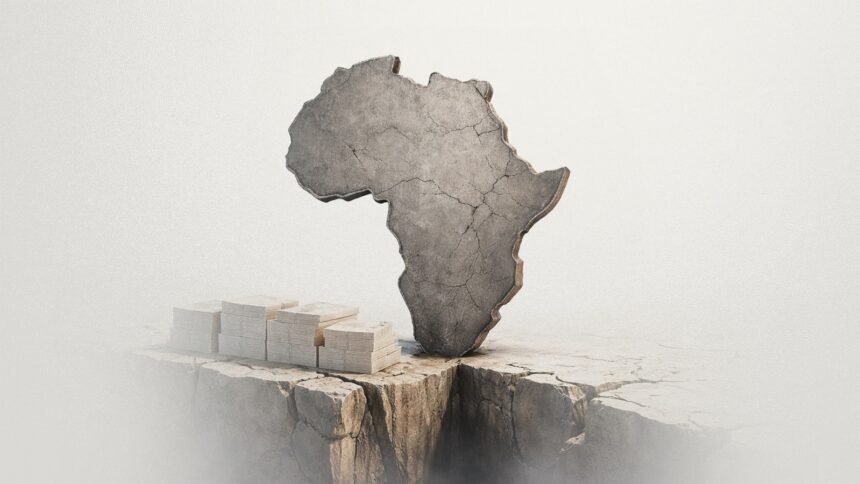
Africa’s debt narrative paints a continental canvas of mounting pressures and strategic pivots, where a $90 billion external repayment wall in 2026 looms as a pivotal test of fiscal resilience. Across the region, public debt-to-GDP ratios hover at 63%, with interest payments devouring 15% of revenues—figures that exceed pre-pandemic levels and divert $89 billion annually from essential SDGs. This dynamic, amplified by global shocks from COVID-19 to commodity slumps, leaves 40% of nations in distress or at high risk, a stark escalation from 2012’s threefold smaller repayment burdens. Sub-Saharan Africa’s 22 low-income states grapple with unsustainable debt burdens, in which borrowing cycles, fueled by thin reserves and concentrated revenues, entrench vulnerabilities. Yet, glimmers emerge: S&P ratings reach post-2020 highs, signaling stabilization through reforms, while the AfCFTA’s intra-trade surge promises a $650 billion GDP uplift by 2043. In this canvas, debt morphs from mere liability to litmus: East Africa’s high-growth hubs like Ethiopia and Kenya contend with climate-fueled spikes, West Africa’s resource giants like Nigeria and Angola navigate oil volatilities, all amid U.S. tariffs and BRICS realignments that reshape creditor landscapes.
Horn’s Heft: East Africa’s Debt Dilemmas and Dynamics
East Africa’s debt dilemmas unfold amid rapid growth and acute exposures, with nations such as Kenya, Ethiopia, and Uganda bearing disproportionate burdens, even as the region is projected to lead continental expansion at 5.8% in 2026. Ethiopia’s $28 billion external stock, exceeding 100% of exports, epitomizes the quandary: Paris Club restructurings and IMF pacts offer breathing room, yet currency devaluations and drought-induced inflation (peaking at 30%) erode buffers, diverting 20% of revenues to servicing the debt. Kenya, with $80 billion in liabilities at 70% of GDP, faces $5 billion in Eurobond maturities, prompting liability management measures such as buybacks to avert default risks amid 7% yields, double global averages. Uganda’s $20 billion debt, half of which is concessional, strains its infrastructure ambitions, as AfDB-backed energy projects clash with repayment humps. Regional synergies through EAC integration promise benefits: harmonized tariffs could reduce premiums by 200 basis points, unlocking $50 billion in green financing. Yet, dilemmas deepen amid geopolitical frictions; U.S. tariffs on Iran ripple through Ethiopia’s $150 million pacts, exacerbating food insecurity for 120 million. In this context, East Africa’s 7% average growth masks fissures: the debt burden’s drag on the SDGs and the need for agile dynamics, such as Pan-African agencies, to recalibrate.
Sahel’s Squeeze: West Africa’s Fiscal Pressures and Pathways
West Africa’s fiscal pressures constrain a region of resource riches and reform resolve, where giants like Nigeria and Côte d’Ivoire face $90 billion in continental repayments amid subdued 4.4% growth in 2026. Nigeria’s $100 billion debt, 60% of GDP, consumes 40% of revenues in servicing, with $15 billion in external dues amplifying naira volatility and inflation at 25%, eroding poverty alleviation for 100 million in distress. Côte d’Ivoire, at $50 billion in liabilities, leverages liability extensions to mitigate Eurobond humps, yet double-digit yields signal investor wariness amid cocoa slumps. Ghana’s $45 billion stock, post-2023 default, underscores pathways: IMF-backed restructurings halve ratios, freeing $5 billion for health, yet mining reforms risk FDI chills. Regional ECOWAS pacts provide ballast, small-arms controls curb violence and costs, while currency unions like ECOWAS aim to stabilize. Pressures mount from jihadist shadows in Sahel states like Mali and Burkina Faso, where $10 billion in combined debts diverts from SDGs, exacerbating 80 million in food insecurity. In this squeeze, West Africa’s 4.6% 2025 dip reflects tariff volatility, yet AfDB synergies promise pathways: $47 billion in inflows for resilient chains, transforming fiscal constraints into balanced booms.
Ledger’s Latitude: Debt Issues in Africa vs. Global Burdens
Africa’s debt ledger reveals stark latitude against global burdens, where $1.1 trillion liabilities, 2% of world public debt, contrast with 26% GDP ratios far below advanced economies’ 300%. This disparity underscores under-leveraging: low-income states borrow at 9.8% yields, triple G7 averages, yielding $921 billion interest outflows in 2024, while household debt lingers at 15% GDP versus 100% elsewhere. Vs. Asia’s 24% global share, Latin America’s 5%, and Africa’s modest 63% ratio mask distress: 40% of nations at risk, with services eclipsing health in 38 states, diverting $89 billion from the SDGs. Global contrasts sharpen: the U.S.-China duo drives $346 trillion in global debt at 349% of GDP, yet Africa’s $707 billion external stock, netting $101 billion in service in 2025, fuels cycles of ratings downgrades and capital flight. Latitude lies in composition: 43% of private creditors thwart restructurings, unlike HIPC’s multilateral focus, which halved ratios. In this ledger, Africa’s burdens, exacerbated by climate-related droughts ($28 billion) and tariffs, demand a global recalibration: debt swaps unlocking $150 billion to bridge the gap toward equitable outcomes.
Lenders’ Locus: AfDF and World Bank in Debt Relief Dynamics
The lenders’ locus in Africa’s debt relief pivots on AfDF’s regional ethos versus the World Bank’s global scale, where synergies and schisms shape East-West dynamics. AfDF, replenished at $25 billion for 2023-2025, channels concessional financing to 37 low-income states, with a focus on climate swaps and infrastructure. $47 billion in inflows counter U.S. aid cuts, with ADF-17 targeting a $10 billion boost. Vs. IDA’s $93 billion envelope, AfDF’s ubuntu lens, embeds preferred-creditor status, exempting it from Paris Club haircuts, enabling $20 billion of callable capital for crisis buffers. In East Africa, AfDF’s $5 billion Ethiopia pacts focus on resilience trusts, whereas the World Bank’s $4 billion Kenya loans are tied to sustainability analyses. Yet, the Common Framework torpor (1,138 days for Zambia) highlights schisms: private opacity thwarts parity. West Africa’s $300 million in Nigerian fertilizers from Iran underscores diversification, with AfDF’s green bonds mobilizing $50 billion against the World Bank’s $30 billion in climate commitments. Dynamics demand fusion: joint Lomé conclaves advocate hybrid relief, reducing 300-basis-point premiums through Pan-African agencies, transforming the locus from competition to collaborative leverage.
Vista’s Veil: Economic Outlook Amid Debt Shadows
Africa’s economic outlook veils promise beneath debt shadows, with 4% growth in 2026, outpacing the global 3.2%, yet uneven across the East’s 5.8% surge and the West’s 4.4% moderation. East’s Ethiopia (7%) and Kenya (5.5%) harness reforms, IMF pacts, and AfCFTA booms, yet $27 billion in Egyptian repayments (one-third of the continental tally) cast veils: 4.1% North African dip reflects tourism rebounds clashing with debt humps. West’s Nigeria (3.5%) and Côte d’Ivoire (6%) navigate oil slumps and cocoa volatilities, with $15 billion dues amplifying 3.5% deficits. Continentally, 4.5% GDP ascent, $650 billion AfCFTA uplift by 2043, lifts 32 million from poverty, yet shadows deepen: 40% distress risk, $101 billion service outflows, tariffs shaving 0.5% growth. Vista brightens with 3.6% inflation moderation, enabling SARB to ease policy, while BRICS naval ties affirm autonomy. In this vein, outlook hinges on unshadowing: $150 billion Compact unlocks, green transitions mobilize $50 billion, charting resilient vistas beyond debt’s dim.
Progress Pathways: Development in Debt’s Wake
Development’s progress pathways in Africa’s debt wake carve resilient routes, where East-West crises catalyze transformative strides. East Africa’s Uganda and Kenya leverage liability extensions and buybacks to ease $5 billion in maturities, for SDG infusions: $50 billion in green financing bolsters renewables, lifting 19 million out of poverty via manufacturing-led $168 billion output by 2043. West’s Benin and Côte d’Ivoire mirror: $47 billion AfDB inflows fuel eco unions, slashing illicit $88 billion outflows through AU pacts. Pathways pivot on integration: AfCFTA’s 52% trade surge by 2032 harmonizes tariffs, while Pan-African agencies cut premiums 200 basis points, freeing $20 billion for health-education eclipses. Vs. Global $102 trillion debt, Africa’s $707 billion stock demands tailored progress: hybrid relief clusters, SDR rechanneling, countering the U.S. tariffs’ 0.8% GDP drag. In this wake, development transcends crisis; ubuntu’s collaborative currents birth equitable pathways, where debt’s detritus yields a developmental dawn.