





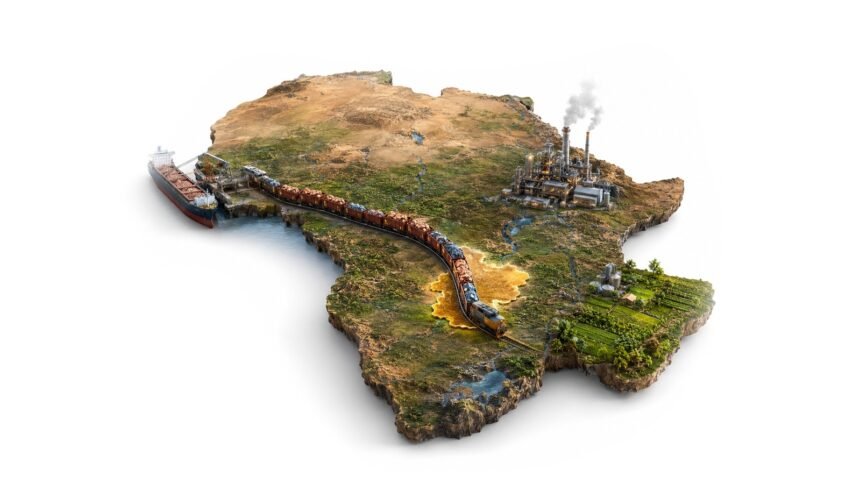
The Pan-African Paradigm of Logistics Sovereignty and Resource Governance
Across the African landscape, the contemporary configuration of international resource politics places intense pressure on developing states to balance raw materials extraction with the assertion of economic sovereignty. The Pan-African vision for regional integration and structural transformation relies heavily on moving beyond legacy colonial corridors designed solely for resource extraction toward building multi-modal domestic logistics networks. When external global rivalries shape sub-continental transport networks, local administrations face the complex task of aligning foreign infrastructure capital with national development plans. Reclaiming Africa’s economic future demands a coordinated approach to logistics governance, ensuring that cross-border economic pathways function as integrated industrial zones that process, refine, and add value to strategic assets within continental borders.
Structural Realignment and the Copperbelt Hub
An intensive legislative and structural re-engineering of the extraction sector inside the Republic of Zambia characterizes the contemporary macroeconomic landscape of Southern Africa. As Africa’s second-largest producer of copper, the country sits at a critical node in global supply chains, particularly as international demand for metals vital to the global energy transition surges. To capitalize on this geological advantage, the state is aggressively pursuing plans to expand its extraction capacities and modernize the logistics systems linking its historic North-Western and Copperbelt Provinces to international trade networks. By implementing comprehensive policy realignments, national planners aim to transition the country from a passive, raw-materials extraction hub to a highly integrated, technologically advanced logistics and processing center.
The Lobito Corridor and Sub-Regional Integration
The strategic execution of resource development across the Southern African Development Community (SADC) has entered a highly integrated phase, centered on expanding the Lobito Corridor. This vital economic pathway is anchored by a high-capacity rail link connecting the mineral-dense interior of the Democratic Republic of Congo, the continent’s top copper and cobalt producer, and Zambia directly to Angola’s Atlantic port of Lobito. For SADC member states, this cross-border corridor represents a major structural shift toward regional integration, lowering transport costs and reducing reliance on congested transit networks. By linking the copperbelts of the sub-continent directly to an Atlantic shipping gateway, the corridor serves as an essential logistics artery that accelerates cross-border trade and harmonizes industrial output frameworks.
The Capitalization of the Millennium Challenge Corporation Program
The changing dynamics of the global green transition have triggered intense competition between Western states and China over access to critical minerals, prompting a significant shift in American economic diplomacy. In a major bilateral development finalized in mid-June 2026, the Zambian government and the United States Millennium Challenge Corporation formally agreed to expand the operational scope of a massive $491 million grant program. Originally signed in 2024 as a “farm-to-market” initiative dedicated exclusively to boosting agricultural development, this substantial funding program is undergoing a strategic realignment. Under the updated framework, some of the capital will be redirected to support key infrastructure tied to the Lobito Corridor, including the rehabilitation of priority road segments in critical mineral-producing provinces. This funding shift highlights Washington’s use of non-debt-creating development grants to secure strategic Western access to critical metals in sub-Saharan Africa.
The Intersection of Agrarian Integrity and Technical Mitigation
The expansion of critical mineral logistics architectures across sub-Saharan corridors requires a balanced approach to ensure environmental protection, agrarian integrity, and ecological safety. Because the restructured $491 million grant program now simultaneously targets both the agricultural and critical minerals economies, regulatory bodies must manage the environmental overlap between mining infrastructure and local farmland. Large-scale infrastructure expansions carry inherent ecological risks, including potential soil erosion, habitat fragmentation, and the contamination of nearby rural water basins. To mitigate these threats, the state is introducing strict environmental monitoring codes alongside infrastructure upgrades, verifying that the construction of advanced transport corridors does not degrade local agricultural ecosystems or compromise the food security of rural communities.
Upgrading Engineering Standards and Local Human Capital
The long-term success of the updated infrastructure program depends heavily on the systematic transfer of advanced engineering technologies and logistics management skills to the local workforce. Constructing durable, high-capacity transport linkages capable of handling heavy mineral cargo requires specialized civil engineering techniques, advanced materials science, and modern project management software. The bilateral agreement between Lusaka and Washington requires that a significant portion of infrastructural operations utilize local technical personnel, contractors, and research bodies. By integrating local institutions into the planning, design, and execution of corridor rehabilitation projects, the initiative helps upgrade domestic human capital, ensuring that local engineers and transport planners acquire the technical competencies needed to independently manage and maintain complex international logistics networks.
Reengineering Trade Pathways Toward Sovereign Industrialization
The republic’s long-term development plans focus on transforming the subcontinental trade matrix from a basic raw-material extraction system into a diversified, self-sustaining industrial economy. While the lead project developer for the rail link, the Africa Finance Corporation, targets final financial close in the fourth quarter of 2027, the state is using the interim period to strengthen its internal transport links. By realigning the $491 million grant to merge agricultural and critical mineral logistics, Zambia is building a resilient domestic trade network that enables rural agricultural outputs and refined minerals to move efficiently to local and global markets. Success will ultimately be measured by the country’s capacity to leverage these international infrastructure partnerships to seed downstream manufacturing hubs, ensuring a stable, prosperous, and completely self-determining future for the republic.