




The Pan-African Paradigm of Youth Displacement and Structural Despair
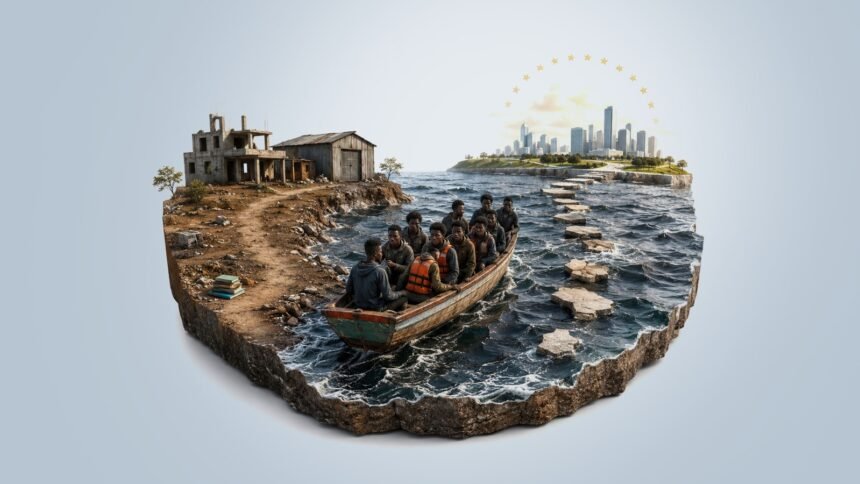
Across the African landscape, the perilous Atlantic migration route to Europe has become a haunting index of the structural despair driving the continent’s young people toward oceans that have already claimed so many. The United Nations refugee agency’s confirmation that 144 people are dead or missing off the coast of Mauritania, following three rescue operations between July 14 and 18, is a devastating data point in a much longer continental narrative: a single vessel that departed from Bufaloto, Gambia, carrying bodies and only 38 survivors after 25 days stranded at sea, among them two children who lost every member of their family during the crossing. This is not merely a tragedy of the sea; it is the visible endpoint of a structural failure of opportunity architecture across sub-Saharan Africa, where the absence of education pathways and formal labor markets renders a 25-day ocean voyage a rational calculation for young people weighing their prospects at home against the risk of death abroad. The Pan-African paradigm demands a reframing of this crisis: not as a European border-security problem to be managed through interdiction, but as a continental development challenge requiring the reclamation of opportunity, dignity, and future-building capacity within Africa’s own borders, so that the desperate calculus driving the region’s youth toward the Atlantic’s currents is no longer the only visible path forward.
The Bufaloto Vessel and the Anatomy of Catastrophe
The scale of the July 18 disaster documented by UNHCR at Nouadhibou is difficult to comprehend in its particulars: 143 people died aboard a single vessel that departed the Gambian coastal town of Bufaloto, with only 38 survivors recovered after nearly a month adrift. UNHCR spokesperson Matt Saltmarsh’s account of two orphaned children now recovering in hospital, having lost every relative during the journey, gives human specificity to what risks becoming a statistical abstraction. The agency was unable to immediately confirm whether deaths resulted from drowning, dehydration, starvation, or some combination, itself a marker of how thoroughly these journeys strip away the basic infrastructure of dignity, down to the certainty of how a life ended. A separate vessel disembarking in Mauritania on July 14 carried one additional fatality, while the broader tally across three rescue operations in that single week put 387 survivors ashore. That these numbers can accumulate within five days speaks to the sheer volume of movement along this corridor, and the inadequacy of any purely reactive, rescue-based response to a crisis rooted in deep structural push factors.
Structural Alternatives and the Call for Institutional Investment
UNHCR’s response to the disaster included an explicit call for expanded access to education and labor opportunities as alternatives to dangerous sea crossings, language that reframes the migration crisis as fundamentally a development and institutional investment failure rather than a security or enforcement problem. This is the crux of the structural sovereignty argument: interdiction and border enforcement, however resourced, cannot address a phenomenon rooted in the absence of viable economic pathways at home. The victims of the Bufaloto vessel, drawn from across sub-Saharan Africa, represent a demographic increasingly disillusioned with domestic prospects, willing to accept extraordinary mortality risk in exchange for a chance at European opportunity. Any durable response must therefore center African institutions, vocational training systems, youth employment programs, and regional labor mobility frameworks capable of generating the kind of tangible, near-term opportunity that can compete with the pull of the Atlantic route, rather than relying exclusively on downstream rescue capacity in Mauritanian waters.
The Data Beneath the Tragedy: A Declining but Deadlier Route
Statistically, the picture is one of a paradox: overall sea arrivals to Europe on major routes have declined by more than a third this year, with just over 40,000 arrivals recorded compared with 65,407 in the first half of 2025, even as UNHCR describes death and disappearance rates as remaining at “alarming levels.” Mauritania alone has recorded 17 disembarkations in Nouadhibou and Nouakchott so far in 2026, with a total of 2,147 individuals rescued. This divergence, falling volume alongside persistently elevated mortality, suggests that enforcement measures may be succeeding in deterring some crossings while simultaneously pushing those who still attempt the journey toward longer, more dangerous, and less monitored routes. It is a structural irony familiar across the history of migration enforcement: policies designed to reduce arrivals often succeed chiefly in raising the price, in human terms, paid by those who continue to attempt the crossing regardless.
Reclaiming Futures on African Soil
The tragedy off Mauritania’s coast will likely fade from international headlines within days, as such disasters routinely do, folded into an ongoing statistical record of loss along the Atlantic route. But the structural conditions that produced it, the absence of education and employment architecture robust enough to retain the continent’s young people, will persist long after the news cycle moves on. A genuine Pan-African response demands sustained institutional investment in the opportunity structures UNHCR itself has called for: vocational and higher education access, formal labor markets, and regional mobility frameworks that allow young Africans to build futures without staking their lives on a 25-day ocean crossing. Until that investment materializes at scale, the shores of Mauritania will continue to bear witness to a preventable toll, and the continent’s demographic promise, its overwhelmingly young population, will remain as much a source of vulnerability as of opportunity, its trajectory determined by whether African institutions can offer viable alternatives to the deadly calculus of flight.