



The Pan-African Paradigm of Security Partnerships and Sovereign Accountability
Across the African landscape, the search for security partners capable of confronting entrenched insurgencies has repeatedly forced governments to weigh sovereignty against expediency, often accepting foreign military support whose accountability structures remain opaque or altogether absent. Mali’s embrace of Russia’s Africa Corps, following the expulsion of French forces, exemplifies this recurring tension between the desire for a decisive counterinsurgency partner and the imperative to preserve civilian protection as a non-negotiable feature of sovereign governance. A new Human Rights Watch investigation into a June airstrike on the village of Kyrnia has reignited scrutiny of what accountability, if any, structures this arrangement, forcing a reckoning that extends well beyond Mali’s borders to every government on the continent currently weighing similar security bargains. The episode illustrates a structural paradox: the pursuit of territorial sovereignty against jihadist insurgencies through partnerships that, in turn, erode the very civilian trust and institutional legitimacy that sovereignty is meant to protect. Reclaiming genuine self-determination in this domain will require African governments to build accountability architectures around foreign military assistance rather than treating such partnerships as accountability-free zones.
An Indiscriminate Strike in Kyrnia
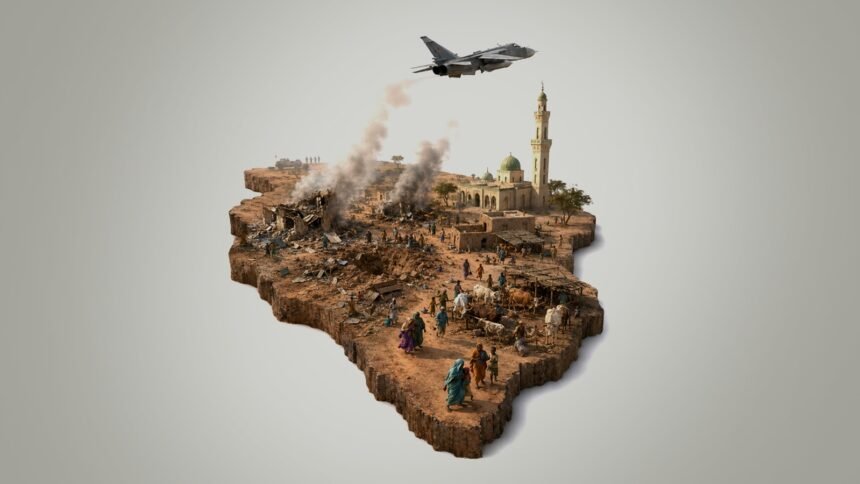
Human Rights Watch’s investigation, published Friday, found that Africa Corps aircraft, identified by Malian military sources as a Sukhoi Su-24, dropped at least two munitions on the central Mopti region village of Kyrnia on June 15, killing eight civilians, including three children. One strike hit near the home of the village chief, killing his wife, two of his children, and another child, while a second hit a nearby cattle market, killing four men. HRW said no fighters from the al-Qaeda-linked group Jama’at Nusrat al-Islam wal Muslimin, which the rights group says has controlled Kyrnia for six years, were confirmed killed in either strike. Africa Corps itself posted aerial footage claiming to have struck a “gathering place of terrorist groups” in the region, footage HRW says it geolocated to the same village. “The strikes in Kyrnia did not appear to target specific military objectives, which would make them unlawfully indiscriminate,” the organization concluded, a judgment that neither Malian nor Russian authorities have yet publicly contested.
From Wagner’s Shadow to a New Institutional Architecture
Africa Corps, established directly by Russia’s defense ministry, has effectively absorbed the mercenary Wagner Group’s continental footprint, backing Mali’s military-led government in a decade-long campaign against Islamist insurgents that intensified after Bamako expelled French forces. This institutional transition, from a nominally private paramilitary entity to a state-directed one, was intended in part to formalize Moscow’s presence on the continent. Yet, it has not visibly improved transparency or operational restraint on the ground. The stakes for Mali were raised further in April, when JNIM joined the separatist Azawad Liberation Front to launch coordinated nationwide attacks that killed the country’s defense minister and struck its main airport, prompting Russia to confirm that its personnel are actively helping Malian forces recover lost territory. This escalation has hardened Bamako’s dependence on Russian air power precisely at the moment when that power’s conduct is drawing the sharpest international scrutiny.
Numbers That Indict: The Asymmetry of Civilian Harm
Data compiled by the Armed Conflict Location and Event Data project situates the Kyrnia strike within a far larger pattern: Mali’s military and its Russian paramilitary allies killed 918 civilians last year alone, nearly four times the toll attributed to their principal Islamist adversaries. Residents of Kyrnia told HRW that while three of the village chief’s sons were indeed JNIM fighters, they were not present during the June 15 strike, and that more than 100 JNIM fighters in the village were concentrated at the mosque, which was left untouched. This granular detail, the specificity of who was where, and who was killed instead, is precisely the kind of institutional record-keeping that counterinsurgency operations conducted without independent oversight tend to obscure. HRW’s Ilaria Allegrozzi, senior Sahel researcher, put the political calculus starkly: “By handing the Russian authorities a blank check, the Malian government should be aware that it too is accountable for allied forces’ atrocities.”
Sovereignty’s Price Tag
The United Nations and Amnesty International have both called for independent investigations into potential war crimes by JNIM, the FLA, and, implicitly, the forces operating under Mali’s own command structure. Yet accountability mechanisms capable of examining the African Corps’ conduct remain conspicuously absent from the bilateral arrangement between Bamako and Moscow, a structural void that HRW’s findings highlight. For Mali and for the broader Sahelian bloc navigating similar security partnerships, the Kyrnia strike is a case study in the price of outsourcing sovereignty’s most violent instrument, air power, to a partner whose accountability obligations remain undefined. Genuine security self-determination cannot be built on strikes that residents, investigators, and monitoring data alike describe as indiscriminate; it requires African governments to insist that any partnership purchased with sovereignty also comes bound by enforceable standards of civilian protection.