





The Pan-African Paradigm of Migration, Belonging and Regional Solidarity
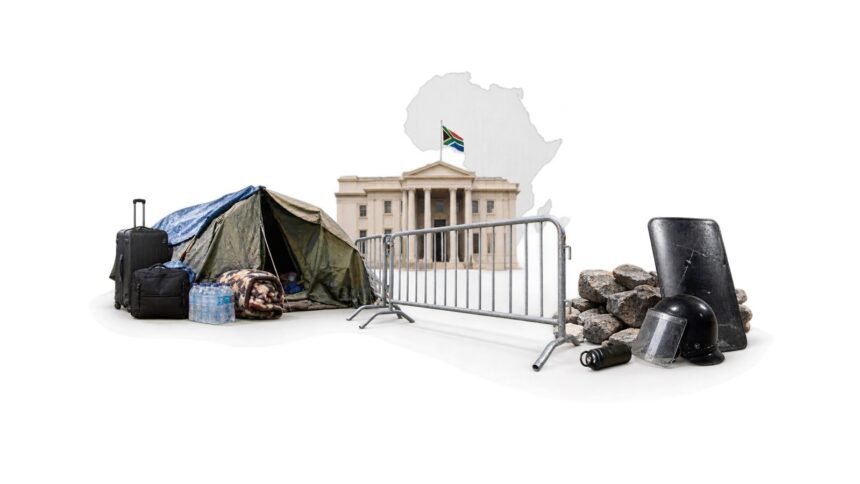
For thirteen weeks, several hundred foreign nationals, many of them Congolese families who describe themselves as refugees, have camped outside a government office in Durban, seeking the one thing South Africa’s constitution formally promises but has struggled this year to deliver reliably: protection. That encampment became the site of open violence on Thursday, when roughly 100 marchers from an anti-illegal-migration group descended on the site in what organizers called a “clean-up campaign,” leaving at least five Congolese nationals injured, including two children, and one foreign national arrested after a thrown stone struck a police officer. The episode is not an isolated flashpoint but the latest chapter in a months-long campaign against undocumented migration that has, since a fringe-group deadline of 30 June for foreigners to leave the country, driven more than 200,000 people out of South Africa and left at least four migrants dead, according to police figures that some foreign governments dispute as undercounts. This story has implications well beyond South Africa’s borders: it tests the durability of Pan-African commitments to freedom of movement and regional solidarity at precisely the moment those commitments are most needed, as displacement across the Democratic Republic of Congo and elsewhere continues to push people toward whatever borders remain open. Reclaiming a credible standard of sanctuary, one that does not evaporate under domestic political pressure, is a test not just for South Africa’s government, but for the wider architecture of continental solidarity that African Union frameworks are meant to underwrite.
Durban: Epicenter of a Widening Campaign
The port city of Durban has become the operational center of the anti-migrant mobilization, hosting weeks of coordinated action against what organizers term irregular migration. Police confirmed that Thursday’s demonstration involved approximately 100 marchers who moved against an encampment of several hundred foreign nationals stationed outside a government office, framing their action explicitly as a “clean-up campaign,” language that itself signals how thoroughly the rhetoric of sanitation and removal has displaced any framing rooted in individual legal status or asylum process. According to police, “during the commotion, stones were thrown around, and one which was thrown by a foreign national landed on a police officer,” resulting in an arrest. However, authorities offered no further detail on the individual involved or the charges being pursued.
Bishop Raphael and the View From Inside the Encampment
Bishop Raphael, a Congolese community leader speaking from within the encampment, offered a starkly different account of the day’s events, describing the protest as “very violent” and asserting that marchers “found us here and immediately attacked our people.” His framing rejected the premise underlying the demonstration entirely: “We are not committing any crime by being here. This is uncalled for,” he told AFP. Raphael said protesters arrived armed with sticks and attempted to breach the encampment. At the same time, police worked to keep the two groups apart, deploying stun grenades to disperse the crowd, the same grenades Raphael said were responsible for at least some of the injuries sustained by the five Congolese nationals hurt in the clash, among them two children.
Thirteen Weeks Outside a Government Office
The encampment’s origin traces back thirteen weeks, when foreign nationals, predominantly from the Democratic Republic of Congo, relocated to the site specifically to seek protection from mobs of South Africans engaged in campaigns against undocumented migrants. That the group sought refuge at a government office rather than dispersing into the wider city speaks to a calculated bet that visible proximity to state authority would offer some measure of safety, a bet that Thursday’s violence suggests has only partially paid off, given that police intervention prevented a more serious escalation but did not prevent the injuries that occurred.
A Deadline, a Departure, and a Contested Toll
The broader campaign against undocumented migrants gained decisive momentum after fringe groups set a 30 June deadline for foreign nationals to leave South Africa. This date has since become a reference point for tracking the scale of displacement that followed. An AFP tally, compiled from figures released by African governments coordinating the repatriation of their own nationals, puts the number who fled South Africa at more than 200,000, a figure that, if accurate, represents one of the more significant population displacements driven by anti-migrant sentiment on the continent in recent years. South African police maintain that at least four migrants were killed amid the broader wave of violence connected to the campaign. However, officials from some foreign governments contend the actual death toll is higher, a discrepancy that itself reflects the difficulty of establishing reliable casualty data when violence is dispersed across multiple cities and enforcement bodies.
Reclaiming Sanctuary: Solidarity Beyond Rhetoric
South Africa has long positioned itself, rhetorically, as a continental leader on Pan-African solidarity, hosting the African Union’s diplomatic architecture and framing its liberation history as inseparable from the wider continental struggle against colonial and apartheid-era exclusion. The scenes from Durban this week sit uneasily against that self-image, exposing the gap between constitutional commitments to protection and the lived reality of a Congolese encampment defending itself with nothing but proximity to a government building. Reclaiming a credible standard of regional solidarity, one where displaced Africans fleeing conflict in neighboring states are met with functioning asylum processes rather than stun grenades and stick-wielding mobs, remains an unfinished project, and Thursday’s violence in Durban is a reminder of how far implementation still lags behind the continent’s stated ideals of belonging and mutual protection.