





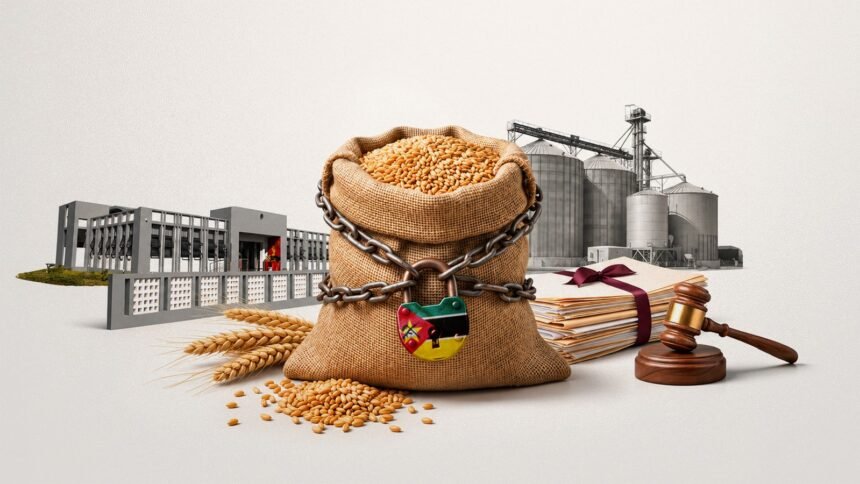
A Grain Monopoly Created by Decree
In 1948, under Portuguese colonial rule, a company was founded that would outlive the empire around it. Companhia Industrial da Matola (CIM) was abandoned by its Portuguese owners after independence, taken over by the state in 1980, privatized in 1995 to Namibia Mills Investments and bought in 2015 by South Africa’s Premier Group. Today it is one of Mozambique’s largest grain importers, and it is at the center of one of two legal fights that are testing how far the state, and the ruling Frelimo party, can control who trades food in and out of the country.
The second fight involves Export Trading Group (ETG), Africa’s largest fertilizer and agricultural commodity trader, which is pursuing a $120 million international arbitration claim against the government. In both cases, the latest moves came on 22 October. Critics, including the main business association, say the government’s actions lack a legal basis; no government response to those arguments has been reported.
The Decree and the Fee
On 31 December 2025, Economy Minister Basílio Muhate gave the Instituto de Cereais de Moçambique (ICM), a government agency, control over imports of rice and wheat. The decree makes the ICM responsible for making rice and wheat available for payment to traders who sell on the domestic market. Business people and non-governmental organizations challenged the monopoly earlier this year, arguing that no law provides for it.
On 12 October, CIM went to the Administrative Court, which rules on the actions of government bodies, accusing the minister and the ICM of acting illegally and of raising the charge paid by importers from $5 to $16 a tonne without authorization. The next day, the ICM suspended CIM and two other companies, África Indústria and the Kenyan firm Pembe, accusing them of “irregular imports”, and confiscated 9,000 tonnes of wheat and 25,000 tonnes of rice from the three. CIM filed an emergency petition, and the court issued a summons certificate, a provisional measure that suspends the effects of the ICM’s action while the case is heard.
On 22 October, the ICM wrote to commercial banks, copying the Bank of Mozambique, telling them to keep requiring its explicit authorization for any import transaction involving CIM and to disregard the court certificate, while notifying the agency if it was presented. The effect, according to the critics, has been to freeze many of CIM’s bank accounts. In late October, Kekobad Patel of the CTA, the main business association, called for the grain monopoly to be suspended immediately, saying it lacks a legal basis and conflicts with Mozambique’s international commitments.
Pigeon Peas and a Dismissed Judge
ETG’s dispute began with pigeon peas, a drought-resistant crop rarely eaten in Mozambique but in demand in India, where it is a staple. When India opened its market to unrestricted imports, Mozambican farmers planted more, and ETG and other traders offered to buy. In July 2023, the ICM unexpectedly imposed tight export quotas. In December 2023, a company called Royal Group obtained a court order in Nacala to seize ETG grain worth about $60 million; by the time the order was reversed, the produce had been exported. Investigative reporting in Mozambique has alleged that Royal Group and people in Frelimo operated a cartel to monopolize pigeon pea exports, with help from police, judges and customs officials. Those allegations have not been tested in court.
What has been established is that in late April 2025 the Superior Council of the Judiciary, the judges’ disciplinary body, dismissed the Nacala-Porto judge who ordered the seizure, Noé Zimpinga, after he was found to have taken $19,000 in bribes to order it and to delay canceling it. By then, ETG had already filed, on 16 October 2024, an arbitration claim at the Permanent Court of Arbitration under the Mozambique-Mauritius investment treaty, seeking $120 million for 40,000 tonnes of pigeon peas, maize and rice. Mozambique has hired Omnia Strategy, a London arbitration firm led by Cherie Blair KC, to defend it before a three-member panel.
An Offer Made in the President’s Office
On 22 October, ETG’s representatives met President Daniel Chapo and proposed a $2 billion fertilizer factory that would use Mozambican natural gas. ETG has the scale to attempt it: founded in 1981 by Mahesh Patel and his family in Dar es Salaam, it now works in 45 countries with annual turnover above $4 billion. The Patel family keeps control, while Japan’s Mitsui owns 32 percent and South Africa’s state-owned Public Investment Corporation owns 14 percent. The group is formally based in Mauritius.
The proposal carries an implicit condition: large investors want assurance that what happened in Nacala cannot happen again. It also revives an old debate. In 2017, the government agreed with Norway’s Yara to build a fertilizer plant using gas from Cabo Delgado and to set up rural distribution, since Mozambican smallholders use far less fertilizer than farmers elsewhere in Africa. The deal did not go ahead; critics say the government preferred to sell its gas to the international energy companies instead.
Control Without Rules
Since taking office in January 2025, Chapo has moved against the most egregious contract abuses of the previous administration, under which many contracts went to party-linked businesses without proper tenders. His government is also creating a centralized state procurement center that should be more transparent, though critics say it will also tighten party control. The grain cases will show which of those tendencies wins.
Who Feeds Mozambique, and on Whose Terms
Food security is a legitimate concern for any government, and a state agency managing strategic imports is not in itself unusual. But economic self-determination depends on rules that bind the state as well as traders: fees set by law, seizures reviewed by courts, and court orders obeyed by state agencies. If the Administrative Court’s ruling in the CIM case is respected, and if the ETG arbitration is resolved on its merits, Mozambique could show investors that its institutions work. If not, the cost will be measured not only in lost fertilizer plants but in the bread and rice prices paid by ordinary Mozambicans.