






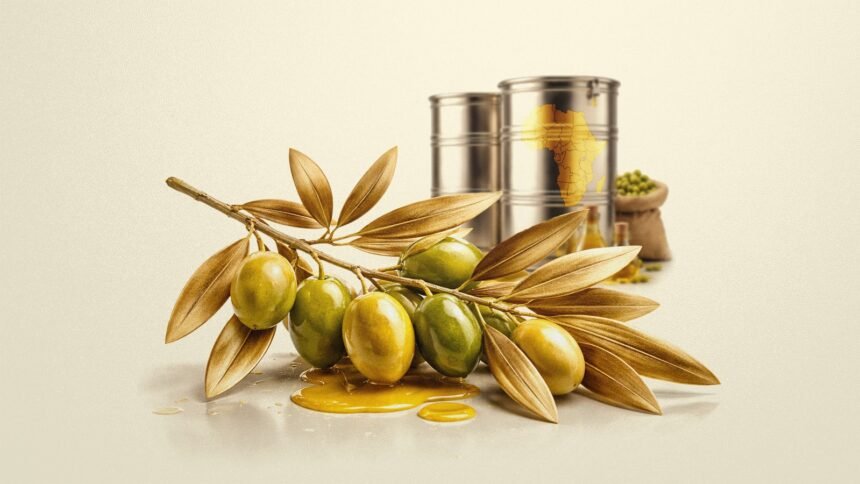
Continental Canopy: Pan-African Olive Oil Panorama
Africa’s olive oil narrative unfolds across its northern and southern fringes, where Mediterranean climates nurture ancient groves that yield a golden elixir integral to global cuisine and economies. Dominated by North African powerhouses, the continent’s production surges amid climatic shifts and market demands, positioning it as a pivotal player in a sector projected to expand from 15.1 billion dollars in 2025 to nearly 20 billion by 2030. Tunisia emerges as the vanguard, with Morocco, Algeria, and Egypt forming a robust quartet, while South Africa’s boutique output adds a southern accent. This pan-African canopy, spanning over 2 million hectares of orchards, reflects a blend of historical cultivation—tracing back millennia to Berber and Phoenician roots—and contemporary expansions driven by European shortfalls, weaving resilience into the fabric of arid landscapes where olives thrive on minimal water and maximal sunlight.
Rift to Root: Leading Nations’ Production Profiles
Tunisia’s olive oil ascendancy crowns it Africa’s premier producer, with 2025-2026 forecasts heralding 380,000 to 400,000 tonnes—potentially peaking at 500,000 in optimistic scenarios—eclipsing Italy to claim global second place behind Spain. This bumper yield, fueled by abundant rainfall and expanded groves, builds on 340,000 tonnes from the prior season, transforming seasonal rhythms into economic lifelines for a nation grappling with debt and stagnation. Morocco follows closely, anticipating 200,000 tonnes in 2025, doubling the previous year’s 90,000 amid a harvest of up to 2 million tonnes of olives, its vast 1.5 million hectares in regions like Meknes channeling high prices into intensified farming. Algeria, with 443,000 hectares expanding toward a million by 2030, sustains a steady output around 80,000-100,000 tonnes annually, its 2024-2025 season promising rebounds from drought dips, emphasizing quality in varieties like Chemlali. Egypt’s arid ingenuity is projected to yield 42,000 tonnes in 2026, with a 3.4 percent growth trajectory, leveraging Nile-fed plantations for both domestic and emerging exports. South Africa, though modest at 1,600 tonnes (1.6 million liters) in 2024—up 33 percent—exhibits strength in premium extra-virgin blends from the Western Cape’s 11,000 hectares, prioritizing artisanal excellence over volume in a market that satisfies only a third of local demand.
Elixir Exchanges: Export Dynamics and Global Flows
Africa’s olive oil exports pulse as vital foreign-exchange earners, with Tunisia’s bulk shipments generating 1.3 billion dollars in 2023, primarily to Italy, where they offset domestic deficits through blending and re-export under European marques—a practice that has sparked transparency debates yet sustains trade volumes. Morocco’s outflows, projected to surge with doubled production, target steady partners in Spain and France, while Algeria’s modest exports—under 10 percent of output—focus on regional markets, hampered by low per-capita consumption but poised for growth via quality certifications. Egypt channels its rising yields into burgeoning ties with South Africa and the US, exploring new avenues amid a 50 percent export potential that remains untapped due to infrastructure constraints. South Africa’s niche consignments, emphasizing high-value extra-virgins, navigate premium channels to Europe and Asia, where awards at international competitions bolster branding. This pan-African exchange, amplified by price spikes to 10,000 dollars per tonne due to European droughts, underscores a shift in which African producers fill global gaps. Yet, bulk-dominant models undervalue origin, prompting calls for value-added processing to capture higher margins.
Grove Guardians: Development Pathways and Innovations
Development in Africa’s olive oil sector charts pathways of adaptation and ambition, where Tunisia’s grove expansions—triggered by lucrative prices—interlace with governmental efforts to achieve record harvests, though political uncertainties deter investment amid the arrests of industry leaders. Morocco’s strategic regreening, integrating modern irrigation across its expansive orchards, aligns with national goals to double outputs, blending traditional Picholine varieties with mechanized harvesting to enhance efficiency. Algeria’s trajectory emphasizes hectare growth and organic shifts, fostering cooperatives that elevate yields and quality and counter climatic volatility through resilient cultivars. Egypt invests in Nile Basin reclamation, adopting drip irrigation systems to increase per-hectare productivity. At the same time, South Africa’s boutique model innovates with sustainable practices like integrated pest management and soil conservation, yielding award-winning oils that command premiums. Pan-African initiatives, from AU-backed research to cross-border knowledge sharing, fortify these guardians against pests and droughts, yet funding shortfalls and climate vulnerabilities demand integrated strategies to sustain momentum, thereby transforming olive cultivation from subsistence to a scalable enterprise.
Marketplace Mosaic: Trade Challenges and Future Horizons
The trade mosaic of African olive oil presents opportunities alongside obstacles, as high global demand—driven by health trends and Mediterranean diet advocacy—interacts with supply chain fragilities and market access barriers. Tunisia grapples with dependence on bulk exports, in which Italian rebranding obscures origins, eroding value capture despite record revenues; political suspicions further chill entrepreneurial spirit, fostering a “wait-and-see” stasis. Morocco faces water scarcity and export quotas, yet its doubling of production signals stronger bargaining in EU pacts. Algeria’s low export ratios stem from a domestic focus and infrastructure gaps, whereas Egypt contends with competition from established players and leverages free trade agreements to penetrate markets. South Africa faces import dominance, with local production accounting for only fractions, compounded by high costs in a premium niche. Future horizons brighten with projected continental growth at a 5.6 percent CAGR to 2030, driven by diversification into bottled, organic lines and Asian-US expansions; yet, harmonizing standards, combating fraud, and mitigating climate risks through resilient agronomy will mosaic this trade into enduring prosperity, positioning Africa’s golden harvests as global cornerstones.


