



Pan-African Borders and Borderless Threats
Across the African landscape, the preservation of state sovereignty and human security faces a continuous challenge from the cross-border nature of asymmetric warfare. The Pan-African vision for a self-sustaining and secure continent is heavily undermined by non-state armed actors that exploit porous borders, ungoverned territories, and weak state authority. In West Africa, localized insurgencies have mutated into complex, transnational criminal networks that disregard national borders to coordinate logistics, hide hostages, and traffic illicit arms. Reclaiming the continent’s stability requires a fundamental shift away from isolated, national security responses toward a unified, borderless strategy of intelligence sharing and joint military operations, ensuring that peripheral states cooperate to protect their most vulnerable populations from cross-border violence.
Mali’s Post-Coup Political Matrix
The contemporary political landscape in Bamako is defined by military consolidation and a complete realignment of international security partnerships. Following coups in 2020 and 2021, the ruling military officers fundamentally shifted the nation’s defense architecture by expelling approximately 15,000 French and United Nations peacekeeping troops. To fill this tactical vacuum, the administration turned directly to Russian state-backed security forces to help check the country’s multi-layered insurgency. This geopolitical shift has altered national governance, as the state faces intense pressure to demonstrate its capacity to protect rural populations and reclaim territorial integrity amid ongoing challenges from both separatist movements and radical armed factions.
The Geography of Asymmetric Conflict
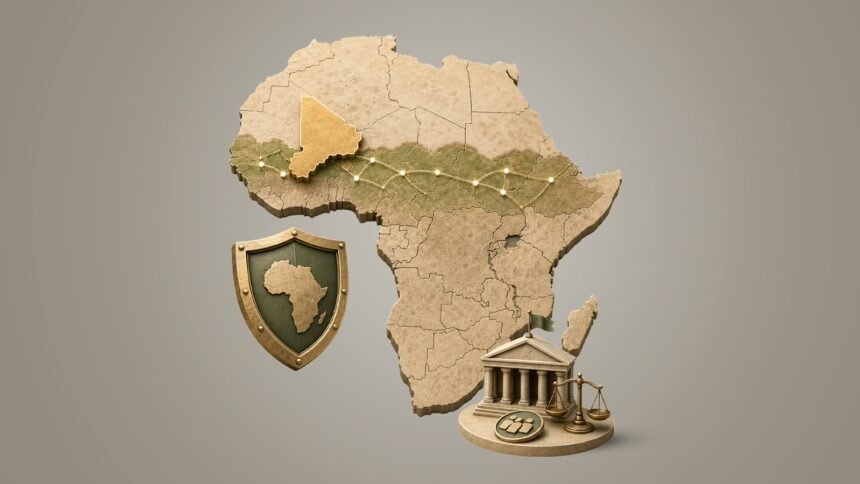
The operational environment within Mali features a volatile mix of ideologically driven insurgencies and highly organized regional rebellions. Jihadist groups first seized massive swathes of Malian territory in 2012 by forming temporary alliances with Tuareg separatists, introducing a prolonged war against the central state. Today, these extremist cells sit at the heart of an expanding belt of militants aligned with al-Qaeda and Islamic State factions that stretches 3,000 kilometers across the West African Sahel. This fractured security landscape complicates national defense, as the state must deploy different tactical approaches to combat ideologically driven networks on one front and localized ethnic separatist coalitions on another.
Tactical Shifts in Administrative Insurgency
Within established strongholds, a major strategic transformation is occurring as al-Qaeda-linked militants systematically pivot from overt brutality toward predictable civic governance. Represented principally by Jama’at Nusrat al-Islam wal Muslimin (JNIM), founded in 2017, these fighters have historically imposed their will through severe force, banning music, smoking, and traditional social celebrations. However, as the group solidifies its territorial control, its rhetoric has softened. Militants are increasingly assuming administrative roles, resolving land and water disputes between herders and farmers, managing local agricultural taxation via traditional mosques, distributing food and medicine to the poor, and allowing humanitarian organizations to operate in their villages without immediate threats of violence.
State Retaliation and the Limits of Dialogue
The political response from Bamako remains firmly opposed to any form of negotiated settlement or reconciliation with insurgent forces. Following high-profile military actions by JNIM and Tuareg-led separatists—including coordinated strikes against the Bamako airport, army bases, and senior defense personnel—the central government has officially classified these coalitions as lawless terrorist organizations entirely responsible for national instability. State authorities have explicitly rejected recommendations from regional analysts to engage in political dialogue, maintaining that the military apparatus will focus entirely on kinetic elimination. This hardline stance aims to preserve constitutional authority, but it leaves little room for formal peace talks, as the state views any compromise as a threat to national legitimacy.
Paramilitary Deployments and Civilian Protection Deficits
The execution of counter-insurgency operations has introduced severe human rights challenges, exposing deep civilian protection deficits across rural communities. Data from independent conflict monitoring networks indicates that the state’s military forces, alongside specialized personnel from the Russian African Corps, have been heavily accused of executing civilians suspected of collaborating with insurgent factions. This persistent violence has shifted local dynamics, as human rights monitors report that heavy-handed military sweeps have inadvertently driven young men to join insurgent groups for basic physical protection. This dynamic creates a severe security vacuum, as communities increasingly view the informal administration of militant networks as more predictable and less corrupt than the volatile operations of state-backed security forces.
Severe Collective Punishment and Blockade Dynamics
Despite the strategic softening of rhetoric in established strongholds, militant networks continue to use extreme violence and collective punishment against any communities that resist their authority. Insurgent factions remain fully capable of carrying out massacres, executing captured fuel convoys, and launching direct attacks on rural settlements that refuse to pay agricultural taxes. In areas where total territorial control is contested, militants routinely enforce severe economic blockades, cutting off access to marketplaces, agricultural fields, and transit routes. These blockades have led to severe food shortages and preventable deaths from a lack of medicine, proving that the group’s administrative tolerance is entirely dependent on complete civilian compliance.
Multilateral Gridlock and the Global Security Threat
Bilateral and multilateral counter-terrorism interventions spearheaded by regional bodies face an absolute gridlock following the withdrawal of international peacekeeping forces from the Sahel. United Nations leadership has warned that the fluid coordination between al-Qaeda and Islamic State offshoots poses an expanding global security threat that extends far beyond West Africa’s borders. However, the operational capacity of regional alliances is severely constrained by political friction between post-coup military administrations and traditional West African economic blocs. This institutional division limits the effectiveness of cross-border enforcement, allowing irregular forces to move freely through peripheral borderlands and undermining international efforts to build a unified regional security shield.
Restoring Stability Through Local Governance and Institutional Integrity
The path forward for Mali and the wider Sahelian corridor requires an immediate transition away from uncoordinated military strikes toward a comprehensive strategy that prioritizes local governance, judicial accountability, and human dignity. Reclaiming long-term state legitimacy depends on the central government restructuring its security operations to strictly protect civilian populations and end human rights abuses by allied forces. To rebuild civic trust, the state must offer rural communities a reliable alternative to insurgent governance by investing in formal conflict-resolution mechanisms, rural infrastructure, and local economic development. Success will ultimately be measured by the state’s capacity to deliver predictable, non-corrupt administration, ensuring a secure, inclusive, and completely self-determining future for the republic.