






Pan African Solidarity: Building Resilient Foundations
In the face of escalating global trade tensions, Southern Africa’s path forward demands a renewed commitment to continental cohesion. The African Continental Free Trade Area (AfCFTA), now in its fifth year, represents a strategic bulwark against external disruptions, uniting 54 nations in a market encompassing more than 1.4 billion people and a collective GDP of nearly $3.5 trillion. For Southern African states—South Africa, Lesotho, Namibia, Botswana, and others—this framework is not merely aspirational but essential for mitigating the fallout from international economic frictions.
Historical legacies of colonial division have long fragmented regional economies, leaving countries vulnerable to commodity price swings and foreign policy whims. Yet, the AfCFTA’s emphasis on tariff reductions, standardization of regulations, and cross-border infrastructure offers a counter-narrative. In Lesotho, where garment exports have plummeted due to external pressures, intra-African trade could absorb displaced production, fostering local value chains in textiles and agriculture. Projections indicate that full implementation might boost regional GDP by 3-4% annually, creating up to 35 million jobs by 2030, with Southern Africa poised to gain from enhanced agro-processing and mineral beneficiation.
This solidarity extends beyond economics to strategic autonomy. As global powers vie for influence, Southern African nations must prioritize collective bargaining. Initiatives such as the Southern African Development Community (SADC) industrial strategy, which aims for 20% intra-regional trade by 2027, underscore the need for unified responses. By investing in rail networks, such as the expansion of the North-South Corridor linking Durban to Dar es Salaam, the region can reduce dependency on volatile overseas markets, ensuring that economic sovereignty translates into tangible prosperity for its 300 million inhabitants.
Tariffs’ Grip: Navigating Protectionist Waves
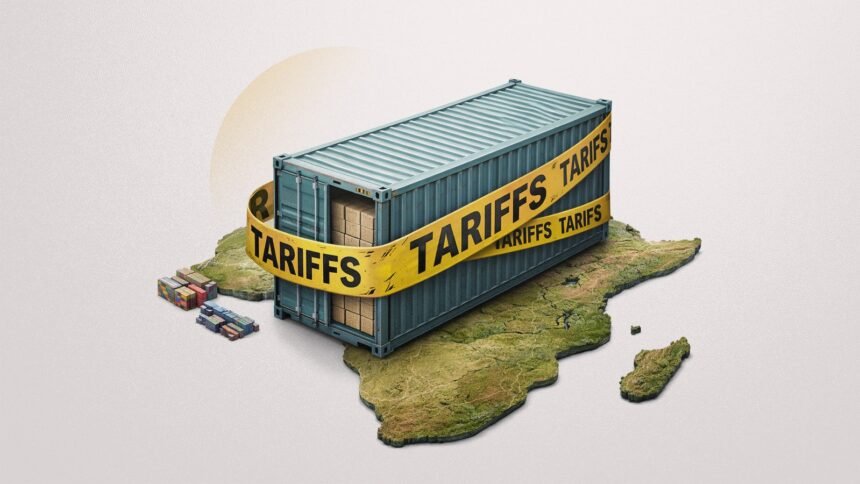
The resurgence of protectionism, led by the United States’ sweeping tariffs, has cast a long shadow over Southern Africa’s export-driven sectors. Implemented in 2025, these measures—ranging from 10% to 60%—have disproportionately affected vulnerable economies, exacerbating unemployment and stifling growth. In Lesotho, the garment industry, once employing 50,000 at its peak, now operates at reduced capacity, with 400 layoffs reported and factories idling at 5-30%. Wages, already meager at around £115 per month, have driven workers into precarious informal employment, highlighting the human cost of trade barriers.
Broader regional impacts are evident. South Africa’s automotive exports to the US have halved, threatening thousands of jobs in assembly plants. Namibia and Botswana face hurdles in beef and diamond shipments, while Zambia’s copper exports contend with redirected global supplies. The expiration of the African Growth and Opportunity Act (AGOA) in September 2025 exacerbated these challenges, imposing duties of up to 30% on previously exempt goods. Although a three-year renewal bill advanced in Congress by late 2025, uncertainty lingers, with the administration favoring a shorter extension.
Yet, these tariffs present a dual-edged sword. They compel diversification, pushing Southern Africa toward alternative markets and domestic innovation. Reduced U.S. access has accelerated shifts toward intra-regional trade, with SADC exports rising by 15% in 2025. Policymakers must counter with targeted protections, such as anti-dumping measures and subsidies for key industries, to shield against further erosion. As global commerce reroutes, the region stands at a pivotal juncture: endure short-term pain or harness it to forge self-reliant supply chains.
Economic Horizons: Charting Growth Amid Uncertainty
Southern Africa’s economic landscape in 2026 reflects a blend of resilience and fragility, with projections signaling modest expansion amid persistent headwinds. The International Monetary Fund anticipates sub-Saharan growth at 4.1% for the year, driven by commodity rebounds and infrastructure gains, though Southern Africa lags at 2.8-3.3%. South Africa, the region’s powerhouse, is forecast to grow at 1.1%, hampered by energy constraints and fiscal deficits. In comparison, Angola and Zambia are projected to see a 3-4% increase from oil and mining recoveries.
Challenges abound. Debt burdens afflict nations like Zambia, where servicing costs consume 25% of revenues, diverting funds from health and education. Infrastructure gaps—estimated at $100 billion annually—hinder connectivity, with only 40% of roads paved. Climate vulnerabilities compound this, as droughts in Zimbabwe and floods in Mozambique reduce agricultural output by 15-20%, thereby inflating food prices and fueling inflation by 7-10%.
Opportunities emerge in diversification. South Africa’s renewables sector, bolstered by private investments, could add 2 gigawatts in 2026, easing blackouts. Mineral-rich states like the Democratic Republic of Congo and Botswana leverage global demand for cobalt and diamonds, potentially swelling revenues by 10-15%. With youth comprising 60% of the population, harnessing this demographic dividend through skills programs could spawn 10 million jobs in tech and services. Fiscal prudence, including debt-for-climate swaps, will be key to unlocking sustainable trajectories.
Southern Africa Spotlight: Regional Realities and Responses
At the epicenter of trade disruptions, Southern Africa grapples with sector-specific vulnerabilities while charting adaptive strategies. Lesotho’s textile woes epitomize the crisis: exports to the US, once tariff-free under AGOA, now face 15% duties, slashing orders and forcing pivots to lower-value South African markets. Factories like Ever Successful Textiles operate at 80% capacity, down from full utilization, underscoring the ripple effects on women-dominated workforces.
South Africa’s multifaceted economy absorbs broader shocks. Vehicle exports declined by 50%, affecting suppliers in Gauteng and the Eastern Cape; however, the citrus and wine sectors have redirected to Europe and Asia, mitigating losses. Namibia’s fishing industry faces higher costs, whereas Botswana’s diamonds benefit from ethical sourcing requirements. Regional integration through SADC provides buffers: trade within the bloc surged 18% in 2025, with protocols facilitating seamless border crossings.
Forward-looking, 2026 demands innovation. Public-private partnerships in logistics, such as upgrading Maputo’s port, could enhance export competitiveness. Embracing digital trade—e-commerce platforms linking producers to African consumers—promises 5-7% GDP gains. By prioritizing local content in mining contracts and agro-industrial zones, Southern Africa can transform adversity into a catalyst for inclusive growth.
Africa-US Dynamics: Strained Alliances and Strategic Shifts
The evolving Africa-US relationship, strained by tariffs and policy divergences, tests Southern Africa’s diplomatic agility. AGOA’s lapse exposed dependencies: Lesotho’s $237 million in U.S. exports dwarfed imports, triggering a 50% initial tariff threat, reduced to 15%, yet chilling growth forecasts to under 1%. South Africa’s stance on global issues, including Palestine and Venezuela, has drawn scrutiny, risking exclusion from preferential trade.
Renewal prospects offer glimmers: Congressional moves toward a three-year extension could avert escalation, though the administration’s one-year preference injects volatility. Broader US tariffs add $5 billion to African export costs, prompting retaliatory measures like entry bans on Americans in some nations. Southern Africa, with $40-50 billion in annual US trade, faces asymmetric losses, particularly in apparel and autos.
Adaptation is imperative. Diversifying partners—bolstering ties with the EU, which absorbs $355 billion in African exports—cushions the impact. Diplomatic engagement, addressing U.S. concerns regarding security and human rights, could restore access. For 2026, balancing moral stances with economic pragmatism will define the region’s trajectory, ensuring alliances serve development rather than division.
US vs. China Rivalry: Opportunities in Geopolitical Flux
The intensifying US-China rivalry reframes Southern Africa’s economic landscape, positioning the region as a pivotal arena for investment and influence. US tariffs have accelerated China’s pivot: exports to Africa surged 35% in 2025, reaching $296 billion, with zero-tariff access extended to 53 states. In Southern Africa, this manifests as $13 billion in Chinese FDI in South Africa and infrastructure pacts in Angola and Zambia.
Benefits accrue from deploying renewables and minerals: Chinese firms inject affordable solar technology, potentially electrifying 200 million off-grid households, while joint ventures in Congo’s cobalt mines fuel green transitions. Trade imbalances persist—a $62 billion deficit favors Beijing—but yield affordable imports, slashing energy costs 15-20%.
Risks include deindustrialization: cheap imports threaten local textiles in Lesotho and South Africa, echoing patterns of dumping. To capitalize, Southern Africa must enforce local content quotas (40-60%) and leverage AfCFTA for regional prioritization. Bargaining as a bloc, harnessing 30% of global critical minerals, can secure tech transfers, transforming raw exports into value-added industries amid superpower contestation.
Development Pathways: Forging a Prosperous Future
Southern Africa’s development horizon in 2026 hinges on leveraging disruptions for transformative growth. A demographic bulge, 1.2 billion under 25 continent-wide, pairs with mineral wealth to promise 7% annual expansion through green manufacturing and agro-hubs. AfCFTA’s protocols could quintuple intra-trade, birthing 20 million jobs and halving poverty by 2035.
Strategic imperatives include $130 billion in annual infrastructure investment, blending Gulf funds with Chinese loans to build resilient grids. Debt relief via nature swaps unlocks $500 million for conservation, while fintech booms and digitizes economies. Leading economies—South Africa ($426 billion GDP) and Angola ($120 billion)—must spearhead reforms, prioritizing the SDGs through a $1.3 trillion mobilization.
This era demands audacity: equitable bilateral pacts, diversified exports that swell GDP by 40%, and sovereign innovation. Unbound from external whims, Southern Africa authors its epoch of affluence and equity.


