





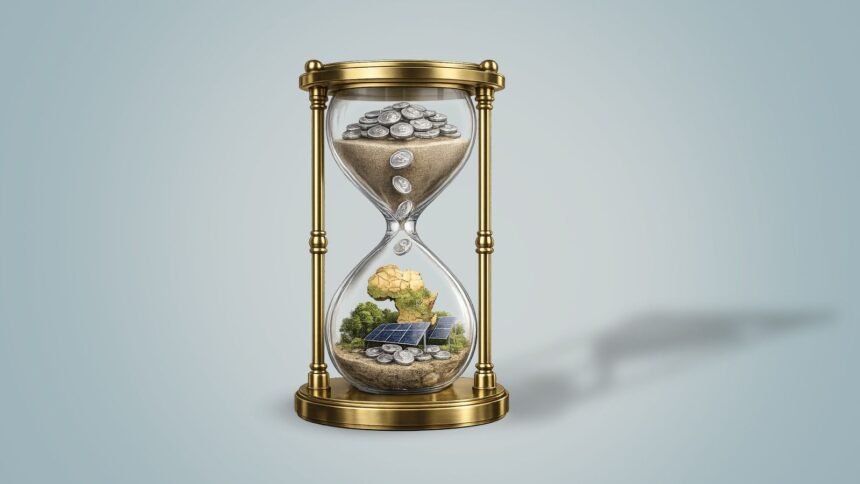
From African capitals, the global climate debate looks very different from what it does from New York, Brussels, or Beijing.
On paper, Africa is at the heart of the world’s climate story: a continent rich in solar, wind, and hydropower potential, home to the fastest‑growing youth population, yet responsible for less than a tenth of global emissions. In practice, our climate ambitions often stall at the same familiar bottleneck, not a lack of plans, but a lack of finance we can trust over time.
For many African policymakers, 2026 feels like a turning point. The language of “climate ambition” has become fluent across the continent. We have nationally determined contributions, long‑term strategies, green industrial policies, and energy transition roadmaps.
What we do not yet have, at the scale required, are the predictable multi‑year financial flows that can turn these documents into transmission lines, irrigation schemes, urban transit systems, and coastal defenses. The gap is not simply about how much money is pledged; it is about how that money is structured, over what time horizon, and on whose terms.
From an African perspective, sustainable development and climate action are not two separate agendas. They are the same political project: lifting people out of poverty, expanding access to energy and services, and protecting societies from escalating climate shocks.
All of this is inherently long-term. Power plants, highways, ports, and water systems are built to last decades. Cropping patterns, settlement choices, and urban form can lock in vulnerability or resilience for generations.
Yet the finance on offer to African countries too often arrives in short cycles, three‑year projects, pilots that never scale, or loans priced as if the mere fact of being African is a risk in itself. We are asked to design long‑horizon transitions on short‑term money.
This mismatch is most visible in the energy sector. Africa has more than enough renewable resources to power a development leap. In regions from the Sahel to the Horn, solar irradiation is among the highest in the world; wind corridors along coasts and rift valleys are globally competitive.
But utility‑scale renewables, grid expansion, and regional power pools depend on patient capital with tenors of 15-20 years for solar, 18-25 years for wind. Investors want regulatory stability, credible off‑takers, and assurance that tariffs, contracts, and policies will not be upended midway through a project’s life.
When financing comes in waves tied to political cycles in donor countries, it feeds a stop‑start dynamic: announcements at climate summits, followed by slow disbursements, renegotiations, and, sometimes, quiet cancellations.
From the perspective of African ministries of finance and planning, the result is fragmentation. A country may have dozens of small projects funded by different partners, each with its own conditions, reporting formats, and timelines, but no coherent multi‑year program that can transform an entire sector.
Officials know that what they need are sequences: first, regulatory reforms and capacity building; then, pilot projects; then, scaled investment and regional integration. That arc cannot be compressed into a two‑ or three‑year window.
Yet designing a 10‑ or 20‑year pathway is risky when there is no clarity about whether concessional funds, guarantees, or blended finance will still be available halfway through.
Infrastructure and adaptation deepen this dilemma. Climate change is already reshaping African realities: erratic rainfall, more intense floods and storms, longer heat waves, and encroaching seas.
Roads that were adequate 20 years ago are now repeatedly washed out; informal settlements are increasingly exposed to floods and heat; coastal communities face erosion that undermines homes, livelihoods, and cultural heritage.
Building infrastructure to withstand these pressures costs more upfront but saves enormous sums over time in avoiding damage and disruption. However, when governments must operate under tight fiscal constraints and short financing windows, the temptation is to build for yesterday’s climate because it is cheaper today, and to hope that disaster relief will fill the gap when the inevitable happens.
Adaptation finance, viewed through the lens of African communities, reveals a deeper asymmetry in the global system. A farmer who adopts climate‑smart practices, a municipality that invests in drainage and green spaces, or a health system preparing for changing disease patterns is generating public goods that benefit both the country and the wider world by fostering stability and reducing humanitarian crises.
These returns are real, but not easily captured as cash flows. That is why adaptation cannot rely primarily on commercial finance. It needs grants, highly concessional loans, and innovative risk‑sharing instruments, deployed over many years, not in one‑off projects.
When adaptation is treated as a side program or humanitarian line item, rather than a core pillar of development finance, Africa is effectively told to bear the mounting costs of a crisis it did not create.
This is not a story of African passivity. Across the continent, governments and regional institutions are working to strengthen the investment environment: reforming energy regulation, improving procurement systems, consolidating project preparation facilities, and creating green investment banks or sovereign funds.
There is growing recognition that domestic resources, from pension funds to insurance pools, must play a greater role. That credible local institutions are essential to mobilize both domestic and international capital. Civil society and youth movements push for transparency and accountability in how climate and development funds are used, insisting that projects respond to local priorities rather than external agendas.
Yet there are hard structural limits to what domestic reforms can achieve in the face of a global financial architecture that still prices African risk as a monolith.
Many African countries pay far higher interest rates than their peers in other regions with similar fundamentals, diverting scarce fiscal space from investment to debt service.
Multilateral development banks, despite recent reforms, remain cautious in how they deploy their balance sheets, often prioritizing their own credit ratings over the urgency of climate‑resilient development.
Private capital remains concentrated in safer, lower‑return assets in the Global North, while complaining that it cannot find “bankable projects” in Africa, a phrase that often masks deeper discomfort with long tenors, perceived political risk, and currency volatility.
From an African analytical standpoint, the central question for a newspaper like The New York Times is not whether Africa is “ready” for climate finance. It is whether the international system is ready to treat African climate ambition as a shared strategic priority rather than a peripheral charity case. Long‑term, predictable finance is not simply a technical fix; it is a test of whose timelines count.
If global institutions and wealthy countries continue to operate on electoral and news cycles, while asking African societies to plan in decades, the gap between rhetoric and reality will widen.
If, instead, they commit to multi‑year programs co‑designed with African partners, align climate finance with national development strategies, and accept a fairer distribution of risk, then 2026 can mark a genuine inflection point.
Africans are tired of being told that the continent is “the future” while being treated as a permanent exception in financing. We are asked to decarbonize without sacrificing development, to adapt to climate impacts largely caused by others, and to preserve ecosystems that are global public goods.
We are willing to lead in imagining a different development model, one that is cleaner, more resilient, and more inclusive. But leadership requires tools. Without long‑horizon, reliable finance, “Africa’s year to turn climate ambition into action” risks becoming another slogan. With it, the continent can move from managing crises to shaping a shared climate future on its own terms.