



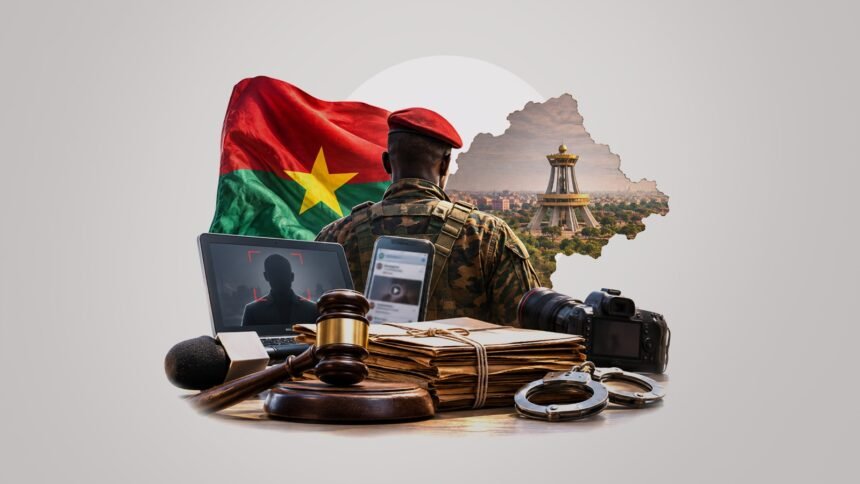
Junta Justice Reaches Beyond the Border
When does criticism from abroad become terrorism? Burkina Faso’s prosecutors gave their answer on Friday 13 November, announcing arrest warrants for about 20 people living in exile, among them journalists, activists, a former foreign minister, former military officers and online commentators, and asking several foreign governments to send them home to face trial.
Désiré Sawadogo, attorney general at the Ouagadougou Court of Appeal, told a news conference that 14 arrest warrants with extradition requests had been issued, alongside seven standard warrants. The accused face charges that include complicity in a terrorist criminal association, complicity in the financing of terrorism, terrorist criminal association, glorification of terrorism and incitement to rebellion. Defamation, attempts to demoralize the national armed forces and contempt of public authority are also cited.
“From abroad, some have chosen to betray their homeland by joining the enemy,” Sawadogo said, in remarks delivered in French, adding that some had done so by becoming communicators on social media.
Who Is on the List
The names reach across Burkinabé public life. The prosecution’s list published by the anti-terrorism unit of the Ouaga II High Court includes Djibril Yipènè Bassolé, a former foreign minister and a pillar of the Blaise Compaoré government in the 2000s, and Newton Ahmed Barry, a journalist who has worked for French international radio. Several commentators who appear on French international broadcasters are also among those named in extradition requests.
Others on the published list include Abdoul Aziz Dabo, Abdoulaye Barry, known as “le Voyageur”, Mamadou Alpha Barry, Johanny Compaoré and D. Roméo Ouoba, known as “Rodriguez”, who are accused of complicity in a terrorist association, in illegal possession of weapons for terrorist purposes and in terrorist financing. Adama Ouédraogo, known as “Damis”, Omar Coulibaly and Naïm Touré are charged with terrorist association and glorification of terrorism, and Dramane Barry with terrorist association and incitement to rebellion.
The prosecutor’s office said more than six cases involving over 45 individuals and legal entities are under investigation by the specialized anti-terrorism judicial unit. Local accounts of the news conference also say investigations have been opened concerning former transitional leader Paul-Henri Sandaogo Damiba and Wassim Nasr, a Paris-based analyst of jihadist movements; the precise legal status of each of those two figures is described differently across accounts.
An Ivorian Influencer and a Request to Meta
One of the most prominent targets is not Burkinabe at all. Camille Makosso, an Ivorian influencer with about four million social media followers known for tirades against the military governments of the Sahel, is not the subject of a warrant. Instead, the justice ministry said it wants him prosecuted “in his country of residence”, Côte d’Ivoire, and hopes Abidjan will act “in the name of international judicial cooperation”. One regional report describes the step against him as an international warrant, so accounts differ on the exact instrument used.
The justice ministry said Burkina Faso had approached several countries, including Côte d’Ivoire, the United States and France, to seek the extradition of some of the accused. The prosecutor’s office also said it had asked Meta to help identify the administrators of pages that it says glorify terrorism, so that legal action can be taken against them, and that it had contacted US judicial authorities about content shared on digital platforms.
A Pattern Since the 2022 Coup
The warrants fit a wider pattern. The military leadership that seized power in September 2022 has cracked down hard on criticism while fighting jihadist violence that has gripped the country for nearly a decade. International media outlets and some of their commentators have also been placed under scrutiny by the authorities.
The charges matter as much as the names. By framing commentary, social media activity and reporting as complicity in terrorism, the authorities place speech inside the most serious category of crime they have. That leaves little room to distinguish between a fighter, a financier, and a journalist who reports on attacks or quotes armed groups. None of the accused has been tried, and the accusations remain allegations by the prosecution.
What Extradition Requests Can and Cannot Do
In practice, the warrants may not bring many of the accused to Ouagadougou soon. Extradition is decided by the courts and governments of the countries where the accused live, which typically weigh such requests against fair-trial standards and the risk that a prosecution is political. Burkina Faso has not said how many of the accused live in each country or how quickly it expects answers.
Yet the warrants still have effects. They can restrict travel, frighten relatives who remain in the country, discourage sources from speaking to exiled reporters and signal to journalists still inside Burkina Faso where the lines now lie. The request to Abidjan over Makosso also puts a direct question to Côte d’Ivoire about how far it will go in acting on a neighbor’s complaint against one of its own citizens.
Security Without Silence
Burkina Faso’s leaders present their policy as a defense of national self-rule against armed groups and foreign interference, and the threat they face is real: the country has been fighting jihadist violence for nearly ten years. But a state’s control over its own destiny is not strengthened by treating its critics as enemies. Citizens can only judge a war they are allowed to hear about.
A durable answer to insecurity in the Sahel will need accurate information about attacks, abuses and failures, including those committed by state forces and their allies. If every critical voice abroad is recast as a terrorism suspect, Burkinabe citizens lose one of the few windows they have onto the conduct of their own war, and the courts lose the credibility they will need when genuine terrorism cases come before them.