





Pan-African Pulse: Sahel’s Ripples Across the Continent
The Sahel’s deepening malaise sends shockwaves through Africa’s pan-African pulse in December 2025, where Mali’s junta-driven disasters exemplify how internal governance failures exacerbate continental vulnerabilities, from jihadist expansions to diplomatic divides. With armed groups controlling over 60% of Malian territory and imposing economic strangleholds on Bamako through road blockades that threaten fuel supplies, the crisis resonates beyond borders: Benin’s December 7 mutiny attempt, swiftly quelled by Nigerian airstrikes, cascades into Burkina Faso’s December 8 detention of 11 Nigerian military personnel, an “unfriendly act” per the Alliance of Sahel States (AES) edict. This pulse throbs with nine coups since 2020, including Guinea-Bissau’s November electoral ouster and Tunisia’s December 2 arrest of human rights advocate Ayachi Hammami under Kais Saied’s repressive regime. Youth unemployment at 42%, narco-trafficking networks funneling billions, and climate-induced displacements—millions fleeing insurgent incursions—amplify the peril, as seen in Sudan’s protracted civil war claiming thousands monthly. The African Union’s Luanda summit last week underscored the urgency. It reaffirmed commitments to counter terrorism and unconstitutional changes, yet enforcement of the Lomé Declaration has faltered amid AES’s defiance of ECOWAS. Without a unified pan-African response—blending debt relief, youth empowerment programs, and cross-border intelligence sharing—the Sahel’s ripples risk eroding continental cohesion, transforming isolated implosions into widespread waves of instability.
Sahel’s Siege: Armed Assaults and Political Paralysis
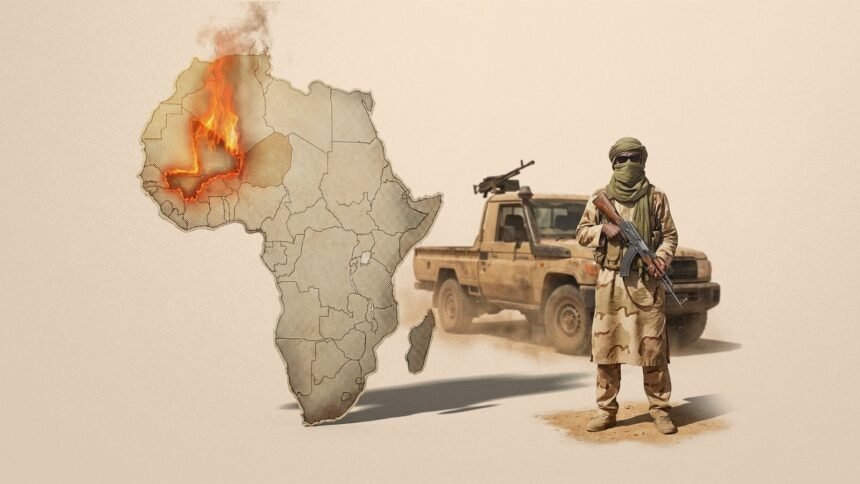
The Sahel’s siege intensifies in 2025, a brutal blend of armed assaults and political paralysis where jihadist groups like JNIM expand territories and execute economic sieges, paralyzing states like Mali with blockades that cut off essential supplies to Bamako. In Mali, where insurgents have complete freedom in vast northern expanses, the junta’s reliance on Russian mercenaries—paid through depleted treasuries and mining concessions—fails to stem the tide, as evidenced by surging casualties and territorial losses post-2023 UN withdrawal. Burkina Faso endures similar assaults, with 2,000 annual deaths from extremist attacks, while Niger grapples with nomadic communities caught in crossfires. Political paralysis compounds the siege: juntas in power since 2020-2023 defer elections indefinitely, suppress dissent through purges, and weaponize anti-Western narratives amplified by Russian disinformation, branding ECOWAS as a neocolonial tool. This paralysis stems from pre-coup complacency—corrupt elites treating states as personal fiefdoms—and post-coup policies that alienate populations, driving recruitment into armed groups. The siege’s scale: over 70% territorial control by non-state actors, intercommunal violence pitting Fulani against Dogon militias, and humanitarian horrors displacing millions. Sahel’s strife signals a siege not just of cities but of systems, calling for regional remedies such as the Accra Initiative to foster cross-border cooperation.
France’s Fading Legacy: Interventions’ Intent and Inevitable Exit
France’s fading legacy in the Sahel, marked by Operations Serval (2013) and Barkhane (2014-2022), reflects the interventions’ intent to stabilize amid accusations of neocolonial overreach. Yet, the inevitable exit in 2022 underscores shared failures in which Paris bore disproportionate burdens without adequate European backing. Initiated at Mali’s 2013 request to halt jihadist advances on Bamako, Serval recaptured key cities like Gao and Timbuktu, preventing state collapse at the cost of 50 French lives. Barkhane expanded to 5,000 troops across the G5 Sahel, focusing on counterterrorism while pushing for political solutions through the 2017 Sahel Alliance, which coordinated governance and development with Germany and the EU. The intent was multifaceted: military action to buy time for Malian state-building, including decentralization and anti-corruption measures, yet the legacy fades amid critiques that Paris prioritized kinetics over root causes such as ethnic alienation and resource inequities. The inevitability of the exit: junta’s post-coup expulsions, amplified by Russian campaigns portraying France as imperialist, led to the UN peacekeepers’ 2023 departure and a resulting vacuum of violence filled by less accountable mercenaries. Fading legacy laments lost traction—tactical successes eroded by lapses in local leadership—yet teaches that interventions require collective commitment, not solitary sacrifices.
Political Unrest’s Undercurrent: Elite Entanglements and Ethnic Estrangements
Political unrest’s undercurrent courses through the Sahel, as elite entanglements and ethnic estrangements erode legitimacy and fuel ferment, from Bamako’s protests to Ouagadougou’s purges. In Mali, Goïta’s junta—nominal vice president turned strongman post-2021 coup—entangles elites in procurement scandals, inflating drone costs threefold, while ethnic estrangements alienate Tuareg and Fulani communities through Bambara-centric policies. Burkina Faso’s Traoré regime, post-2022 coups, entangles warlords in toll extortions, estranging northern populations amid 40% poverty despite gold booms. Niger’s junta estrangements: border closures displacing herders into radical ranks, entangling resources with Russian concessions. Undercurrents undulate continentally—Benin’s December mutiny denouncing northern neglect, Tunisia’s arrest of Hammami amid Saied’s “sham trials.” Elite entanglements: ghost soldiers padding payrolls, aid diversions breeding resentment. Ethnic estrangements: collective punishments in Moura and Sevare, spawning cycles of vengeance. The surge of political unrest, a Sahelian undercurrent, summons surges: national dialogues, equitable resource pacts, and youth integration to bridge gulfs.
West African Whirlwind: Blocs’ Battles and Border Breaches
West Africa’s whirlwind whirls with blocs’ battles and border breaches in December 2025, ECOWAS-AES antagonisms amplifying from Benin’s December 7 coup crush to Burkina’s December 8 detention of Nigeria’s 11 airmen. ECOWAS’s 5,000 standby force—Ghanaian, Ivorian, Nigerian, Sierra Leonean—battles to bolster Benin, while Tinubu’s jets target Tigri’s transients; yet AES issues edicts vowing to vanquish airspace violators. Whirlwind’s whorls: insurgents southward, Burkina’s bleed into Benin’s north, displacing thousands; economic battles, debts devouring GDPs; diplomatic breaches, French fade, yielding Russian rapiers. AES antagonisms: Mali’s mercenary pacts, Burkina’s uranium under radar, Niger’s junta jettisoning aid. West Africa’s whirlwind warns: without welds—preemptive pacts pairing patrols with prosperity—blocs battle boundless, breaches birthing balkanization.
Military Coups’ Menace: Praetorian Pacts and Perpetual Power Grabs
The menace of military coups multiplies in the Sahel, praetorian pacts and perpetual power grabs perpetuating cycles in which soldiers seize states, December’s Benin brush menacing mirrors Burkina’s 2022 consummations. Tigri’s Cotonou caper, quashed swiftly, grabs into AES pacts: Goïta, Traoré, Tchiani thumbing at ECOWAS, justifying “refoundations” amid jihad claiming 2,000 yearly. Menace’s multipliers: Mali’s 2020 maelstrom deferring elections to 2026, Burkina’s tandem yielding termless grips, Niger’s 2023 scorning sanctions, starving billions. Power grabs pivot to patrons: Russian rapiers replacing Barkhane, gold for guns in mercenary matrimonies. Coups’ cascade—Guinea-Bissau’s November, Madagascar’s October—menaces mimicry: praetorians protesting penury, perpetuating through purges. Sahel’s siege, a military menace, mandates muzzles: AU enforcements, civilian controls, youth corps channeling choler.


