






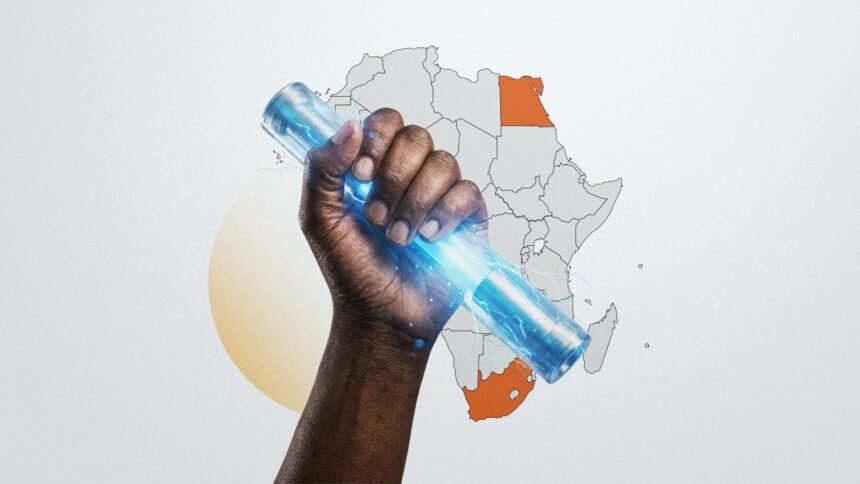
Pan-African Prometheus: Reclaiming Fire in the Age of Great-Power Retreat
The African continent stands at a historic inflection point. For seven decades, its strategic stability has rested on the implicit promise of external protection—first from colonial metropoles, then from Cold War superpowers, and most recently from an American-led order that positioned itself as the ultimate guarantor against existential threats. That promise is fracturing. As extended deterrence erodes elsewhere—from Northeast Asia to Eastern Europe—Africa cannot afford the luxury of believing itself exempt from the same logic. The question is no longer whether the continent should contemplate an independent nuclear capability, but when and how it should begin the long, difficult conversation that will determine whether it remains a geopolitical object or finally becomes a subject.
South Africa’s apartheid-era arsenal (six devices built and then voluntarily dismantled between 1989 and 1993) proved that Africa already possesses the scientific, engineering, and industrial base required. Egypt’s four Russian-built reactors at El Dabaa, Nigeria’s planned Korean-designed plants, Ghana’s advancing regulatory framework, Kenya’s uranium deposits, and Namibia’s world-class uranium mines collectively form the fragments of a latent Pan-African nuclear ecosystem. The African Union’s silence on the military implications of this growing civilian infrastructure is becoming unsustainable. The Pelindaba Treaty of 1996, which declared Africa a nuclear-weapon-free zone, was negotiated in a unipolar moment when American hegemony appeared eternal, and the continent’s primary threats were internal. That world no longer exists.
The structural drivers are merciless. Washington’s second Trump administration has explicitly redefined alliances as transactional burden-sharing arrangements rather than sacred commitments. Its own continental crisis consumes Europe. China’s Belt and Road has morphed into strategic encirclement in critical nodes—the Horn, the Sahel, the Copperbelt—while Russia sells arms and legitimacy to any regime willing to trade sovereignty for survival. In this environment, Africa’s vast deposits of uranium, cobalt, lithium, and rare earths are no longer mere economic assets; they are strategic vulnerabilities that invite intervention. An independent deterrence capability—whether continental, sub-regional, or national—would fundamentally alter the cost-benefit calculus of any power contemplating military or hybrid aggression against African states.
Energy Imperium: Nuclear Power as the Backbone of Continental Industrialisation
Nuclear energy is the only proven technology capable of delivering the quantum leap in baseload electricity that Africa requires to escape the middle-income trap and achieve genuine industrial sovereignty. Renewables, for all their transformative promise, cannot yet provide the 24/7, high-energy-density power demanded by aluminium smelters, steel mills, fertiliser plants, data centres, and electric-arc furnaces. A single large reactor delivers the continuous output of thousands of wind turbines or tens of thousands of hectares of solar panels—without the land-use conflicts that are already slowing renewable deployment in densely populated regions.
By 2040, the continent will need to add at least 15,000 MW of new capacity every year to keep pace with demographic and economic growth. Nuclear is uniquely positioned to meet this challenge. South Africa’s Koeberg has operated safely for four decades, training generations of African nuclear engineers. When complete, Egypt’s El Dabaa complex will add 4.8 GW—equivalent to roughly 15% of current Egyptian generation—from a single site. Morocco, Algeria, and Tunisia are exploring Mediterranean desalination reactors that would simultaneously solve energy and water crises. Even landlocked Rwanda and Ethiopia have signed memoranda with Rosatom and CNNC, respectively, understanding that reliable electricity is the prerequisite for everything from vaccine manufacturing to artificial intelligence hubs.
The economic multipliers are staggering. Every gigawatt of nuclear capacity creates thousands of high-skill jobs during construction and hundreds permanently, while anchoring entire industrial clusters. Localisation requirements—already 40% in South Africa’s planned new build—would reverse decades of de-industrialisation. Uranium from Niger, Namibia, and South Africa could be enriched on the continent rather than shipped in its raw form to France, Russia, or China. Spent fuel reprocessing, safely conducted under international safeguards, would close the fuel cycle and dramatically reduce import dependence. A Pan-African Nuclear Energy Community modelled on EURATOM or the Gulf Cooperation Council’s joint nuclear ambitions could pool resources, harmonise regulation, and negotiate as a bloc with technology suppliers—transforming Africa from price-taker to price-maker.
Shield of the South: The Strategic Deterrence Imperative
Deterrence is not about fighting wars; it is about making certain wars unthinkable. In a world where American nuclear guarantees are increasingly questioned—even in treaty alliances—Africa cannot indefinitely rely on the goodwill of distant powers to protect its resource corridors, its maritime exclusive economic zones, or its territorial integrity. The Democratic Republic of Congo alone contains minerals worth tens of trillions of dollars. The Sahel’s uranium feeds European reactors. The Horn controls the Bab el-Mandeb chokepoint. These are not peripheral interests; they are arteries of the global economy.
A modest, survivable second-strike capability—whether submarine-based, deeply buried, or dispersed across multiple states in a collective defence arrangement—would impose unacceptable costs on any aggressor contemplating regime change, partition, or resource annexation. South Africa’s historical programme demonstrated that a threshold state can achieve deterrence without deploying thousands of warheads. A Pan-African or SADC-based force de frappe, perhaps initially limited to a few dozen weapons on invulnerable platforms, would suffice to shift the continent from prey to peer in great-power calculations.
The moral objection—that nuclear weapons are inherently illegitimate—is potent but selective. The five permanent members of the UN Security Council possess them. Israel, India, Pakistan, and North Korea possess them. None has suffered existential invasion since acquiring the bomb. Ukraine’s 1994 decision to relinquish the world’s third-largest arsenal in exchange for paper guarantees is now taught in staff colleges as the cautionary tale par excellence. Africa, which contributes less than 4% of historical emissions yet suffers the most catastrophic climate impacts, has every right to ask why strategic immunity should remain the exclusive privilege of others.
Sovereign Fission: Building an African Nuclear Order
The path forward requires neither immediate proliferation nor perpetual abstinence, but the deliberate construction of a sovereign African nuclear order. This begins with transparency and collective decision-making. An African Atomic Energy Commission under AU auspices could oversee both civilian programmes and, if member states so decide, a joint deterrence force. Confidence-building measures—open fuel-cycle facilities, multinational crews on future nuclear submarines, continuous IAEA safeguards—would mitigate proliferation risks while preserving strategic autonomy.
Financing models already exist. The BRICS New Development Bank, the African Development Bank, and sovereign wealth funds from Algeria to Nigeria could capitalise a dedicated nuclear investment vehicle. Technology transfer agreements with Russia, South Korea, France, and China—each competing for market share—can be leveraged to maximise local content and knowledge retention. Small modular reactors and floating nuclear power plants offer lower entry barriers for coastal and landlocked states alike.
The political obstacles are formidable. Public opinion, shaped by Chernobyl imagery and anti-apartheid memory, remains deeply wary. Yet the same societies that once accepted Pelindaba as a moral necessity may come to see strategic autonomy as an equally compelling ethical imperative. Leadership will be required—perhaps from Pretoria, Cairo, Abuja, and Addis Ababa jointly—to frame the debate not as a betrayal of non-violence but as the ultimate act of responsibility toward future generations.
Dawn of the Atomic Century
When historians look back on the 21st century, they may identify the moment when Africa began seriously contemplating nuclear capability as the true end of the postcolonial era. For the first time since the Berlin Conference of 1884–85 carved the continent into European possessions, African states would possess the means to enforce red lines drawn by Africans, for Africans.
The choice is not between peace and weapons, but between continued strategic vulnerability and the hard-won dignity of self-defence. The sun that bathes the continent in abundant light also warms the uranium beneath its soil. In harnessing both, Africa can finally step out from the shadow of empires—old and new—and into a future where its destiny is determined not by the whims of distant capitals, but by the sovereign will of its own people. The atomic fire, once stolen by Prometheus from the gods, may yet be reclaimed by a continent long denied its rightful place among the powers of the earth.


