





Pan-African Ecological Security: Reclaiming Biosphere Sovereignty
Across the African landscape, the contemporary configuration of public health architecture cannot be separated from the preservation of environmental integrity. The Pan-African vision for a stable and self-determining continent is increasingly threatened by an asymmetric global trade paradigm that prioritizes raw resource extraction over the ecological stability of host nations. In the Congo Basin, which holds the world’s second-largest rainforest, transnational economic demands have triggered unprecedented environmental degradation. Reclaiming the continent’s shared future requires a comprehensive transition away from reactive, externalized medical interventions toward a proactive model of environmental sovereignty. This strategy must treat the protection of pristine ecosystems not merely as a conservation goal, but as a critical, non-negotiable component of continental defense against emerging infectious threats.
Ebola’s Pathological Anatomy: Rupturing the Enzootic Balance
The biological reality of Ebolavirus transmission has been fundamentally transformed by the rapid acceleration of human incursions into historical viral reservoirs. For decades following its discovery in 1976, outbreaks of the disease remained relatively small and geographically contained, typically affecting a few hundred people in remote locations before burning out. In its natural state, the virus lives quietly within its animal hosts, widely understood to be fruit bats, causing them little to no physiological harm. Furthermore, communities living naturally around these habitats have historically developed a degree of acquired immunity through low-level, repeated exposure, with data indicating that nearly 20% of forest-dwelling populations in regions like Gabon possess immune protection. However, the physical destruction of these habitats has shattered this delicate enzootic balance, shifting the virus from a rare, localized hazard into a high-velocity transnational emergency.
Canopy Loss in the Great Lakes Corridor: The Mechanics of Habitat Compression
The rapid expansion of deforestation across Central and East Africa serves as the primary environmental driver of modern viral spillover. In 2024 alone, satellite data analyzed by Global Forest Watch documented a record loss of 1.5 million acres of the Congo Basin rainforest. This massive canopy loss does not cause native bat populations to disappear; instead, it forces them to compress into the remaining forest fragments, drastically increasing their proximity to human settlements. This habitat fragmentation significantly increases the frequency of human exposure to viral-laden bat blood, saliva, and bodily waste. Macro-level epidemiological analyses from 2025 demonstrate a direct correlation: each percentage-point increase in regional deforestation is associated with a 20% to 40% spike in the incidence of malaria and Ebola. This was vividly illustrated by the 2014 West African epidemic, which was preceded by the destruction of 85% of the forest cover in southwestern Guinea.
The Smartphone Economy: Mineral Extraction and Core Forest Penetration
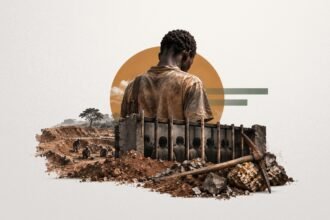
The driving force behind contemporary forest loss in the Democratic Republic of the Congo (DRC) is uniquely tied to the soaring global demand for high-tech components rather than basic human survival. The rapid global race to manufacture semiconductors, smartphones, and electric vehicle batteries has tripled the demand for critical “3TG” minerals (tungsten, tin, tantalum, and gold) alongside cobalt and copper. While the DRC contains an estimated $24 trillion in untapped mineral wealth, persistent political instability has hindered large-scale commercial mining operations, fueling a massive rise in informal, “artisanal” mining. This informal sector employs an estimated 2 million citizens across the republic, including more than 380,000 workers in the eastern provinces. While traditional agricultural expansion pushes into forests gradually from the edges, mineral hunters plunge directly into the pristine core of the jungle, slicing open deep interior frontiers and systematically remaking the underlying ecology of the pathogen.
Climate Shifts and Social Vulnerabilities: The Alternate Livelihood Trap
A combination of climate change and economic realignments is accelerating the rapid expansion of artisanal mining networks. In eastern DRC, rural households are increasingly caught in an economic trap, as erratic rainfall patterns and declining soil fertility severely undermine traditional subsistence farming. Faced with failing crops and markets disrupted by localized conflict, more than 30% of local households have transitioned to artisanal mining as their primary source of livelihood. This shift has been further intensified by international geopolitical competition; following the suspension of US conflict-mineral regulations and a subsequent doubling of global gold prices linked to international trade tariffs, thousands of vulnerable workers have flooded into unregulated mining areas. This rapid migration brings populations that lack any historically acquired immunity into intimate contact with forest wildlife through bushmeat hunting, establishing highly vulnerable human enclaves in makeshift mining towns with notoriously poor sanitation and zero medical infrastructure.
Emergency Mobilization: The Limits of Reactive Intervention
The operational limits of reactive public health models have been starkly apparent in the current multinational outbreak of the Bundibugyo Ebola strain. Originating in the expanding, unregulated gold-mining hub of Mongbwalu in northeastern DRC, the current eruption has quickly caused 363 confirmed fatalities and breached international borders into neighboring Uganda. NASA imagery and satellite mapping from the US Geological Survey (USGS) tracked wobbly lines of bright blue, newly deforested corridors radiating directly out of Mongbwalu, providing clear proof of the link between mining expansion and disease emergence. While international organizations like the CDC and the WHO focus their resources on downstream containment, contact tracing, and emergency field hospitals, these reactive measures are structurally inadequate for managing novel or rare strains that elude standard diagnostic tests. Relying solely on epidemic response while ignoring the environmental destruction that drives initial spillover creates an endless cycle of biological vulnerability.
Reclaiming Primary Prevention: Ecological Restructuring and Global Responsibility
The path toward securing a sustainable and healthy future for the continent requires an immediate shift toward primary ecological prevention as the foundational pillar of pandemic policy. Reclaiming the integrity of the Congo Basin requires national and continental authorities to enforce strict regulatory oversight over mineral supply chains, mandating that international technology conglomerates take direct responsibility for the environmental destruction caused by their upstream suppliers. Governments must invest heavily in climate-resilient agricultural alternatives to provide rural communities with stable livelihoods that do not require entering pristine forest cores. True long-term security will not be achieved by building more containment tents, but by preserving the complex boundaries between human communities and wild reservoirs, ensuring that the minerals inside global consumer technology do not cost the lives and health of African citizens.