


Africa’s Eternal Veins: A Millennium of Extraction and Dispossession
Long before European boots set foot on Congolese soil, African societies mastered the art of mining. Great Zimbabwe rose on gold, the Akan kingdoms of Ghana traded dust for salt across the Sahara, and the Luba of Katanga smelted copper into ceremonial axes that symbolised divine kingship. Colonialism weaponised this knowledge: Belgium’s Congo Free State murdered millions for rubber and ivory, then pivoted to copper and uranium once the atom bomb needed feeding. Independence promised reversal, but structural adjustment, debt crises, and the 1996–2003 Congo Wars turned the country’s mineral heart into a free-for-all. Today, the DRC holds 70 % of global cobalt, half the world’s known reserves, yet ranks 180 out of 191 on the Human Development Index.
The New Scramble: Critical Minerals and the Green Transition
The electric-vehicle revolution and the race to net-zero have resurrected Africa’s subsoil as strategic terrain. Cobalt, lithium, copper, manganese, and graphite—labelled “critical raw materials” by Washington and Brussels—are indispensable for batteries, wind turbines, and defence systems. China currently processes over 80% of the world’s cobalt and 60% of the world’s lithium, prompting the United States and the European Union to launch a counter-offensive built on infrastructure loans, diplomatic memoranda, and flagship rail corridors—their chosen battlefield: the mineral-rich southeast of the Democratic Republic of Congo and the adjacent Zambian Copperbelt.
Atlantic Lifeline: The Lobito Corridor Gambit
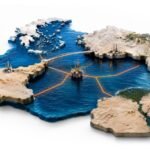
In October 2023, the G7’s Partnership for Global Infrastructure and Investment resurrected the century-old Benguela railway as the Lobito Atlantic Railway Corridor. Stretching 1,300 km from the Angolan port of Lobito through DRC’s Katanga and Zambia’s Copperbelt, the corridor promises to halve transport times and cut carbon emissions by replacing diesel trucks with electric trains. By December 2025, the United States had committed over $600 million in new financing, and the EU had committed €116 million, with total public-private pledges exceeding $4 billion. The prize: rapid evacuation of copper and cobalt from Ivanhoe’s giant Kamoa-Kakula complex and Glencore’s Kamoto mine toward Western rather than Chinese refineries.
Blood in the Battery: Human Rights on the Copperbelt
Behind the gleaming promises lies a darkening reality. In Kolwezi and surrounding towns, industrial mining expansion has displaced more than 30,000 people since 2020. New rail buffer zones announced in 2025 threaten another 6,500 residents with forced eviction. Artisanal miners—estimated at 150,000–200,000 in the DRC, including tens of thousands of children—work in tunnels that collapse weekly, poisoned by cobalt dust and mercury used in gold panning. Sexual violence, military extortion, and lethal confrontations with private security remain routine. Eastern DRC’s conflict, fuelled in part by coltan and gold smuggling that finances M23 rebels, has displaced over seven million people—the world’s largest internal displacement crisis.
Washington’s Pivot: From Aid to Strategic Minerals
The Biden administration reclassified the DRC and Zambia as “minerals security partners” in 2022. The U.S. International Development Finance Corporation (DFC) and the Export-Import Bank have mobilised loans, guarantees, and political risk insurance for American juniors such as KoBold Metals (backed by Bill Gates and Jeff Bezos) and for rail concessions dominated by Trafigura. A revived Air Force base in Angola and expanded military training programmes in DRC reveal the security underside of the minerals push. Critics warn that conditioning investment on alignment against China risks repeating Cold War patterns of backing strongmen in exchange for resource access.
Brussels’ Dilemma: Green Goals versus Ethical Supply Chains
The European Union’s Global Gateway and Critical Raw Materials Act aim to secure 10% of global processing capacity by 2030 while mandating human rights and environmental due diligence. Yet European companies remain deeply implicated: Glencore (Swiss-British), Eurasian Resources Group (Luxembourg-registered), and Umicore (Belgian) operate some of the most significant concessions. The EU’s forthcoming Corporate Sustainability Due Diligence Directive will require firms to identify and mitigate rights abuses throughout their supply chains. Still, enforcement mechanisms remain weak, and voluntary “responsible sourcing” schemes have repeatedly failed to stop child labour or toxic pollution.
The Congolese Crucible: Governance, Corruption, and Lost Revenue
Despite producing minerals worth hundreds of billions, the DRC collected only 5–7% of export value in taxes and royalties between 2015 and 2023, according to the Extractive Industries Transparency Initiative. Opaque joint ventures with Chinese, Emirati, and offshore entities continue to siphon profits through transfer pricing and secret contracts. Dan Gertler’s lingering influence—despite U.S. sanctions—illustrates how politically connected intermediaries still extract rents. Chronic power shortages, collapsing roads, and militia control of artisanal zones further handicap formalisation efforts.
Toward an Equitable Horizon or Another Century of Extraction?
The Lobito Corridor and parallel US-EU initiatives could, if radically reoriented, become instruments of genuine development: rail-linked solar plants to power local smelters, mandatory joint ventures with at least 30 % Congolese ownership, and ring-fenced royalties feeding a sovereign mineral fund. Without such safeguards, the green transition risks becoming the latest chapter in a long history of external powers harvesting Africa’s wealth while leaving violence, poverty, and environmental ruin in their wake.
The choice is stark. Either the Democratic Republic of Congo remains a sacrificial zone for the world’s clean-energy ambitions, or the Atlantic partners rewrite the terms of engagement—placing human rights, local processing, and democratic accountability at the centre of every deal. The veins of the continent are deep, but the patience of its people is not infinite.